CircleCI Chunk Sidecars are set to change how AI-generated code is tested and validated, bringing continuous integration capabilities directly into the development process.
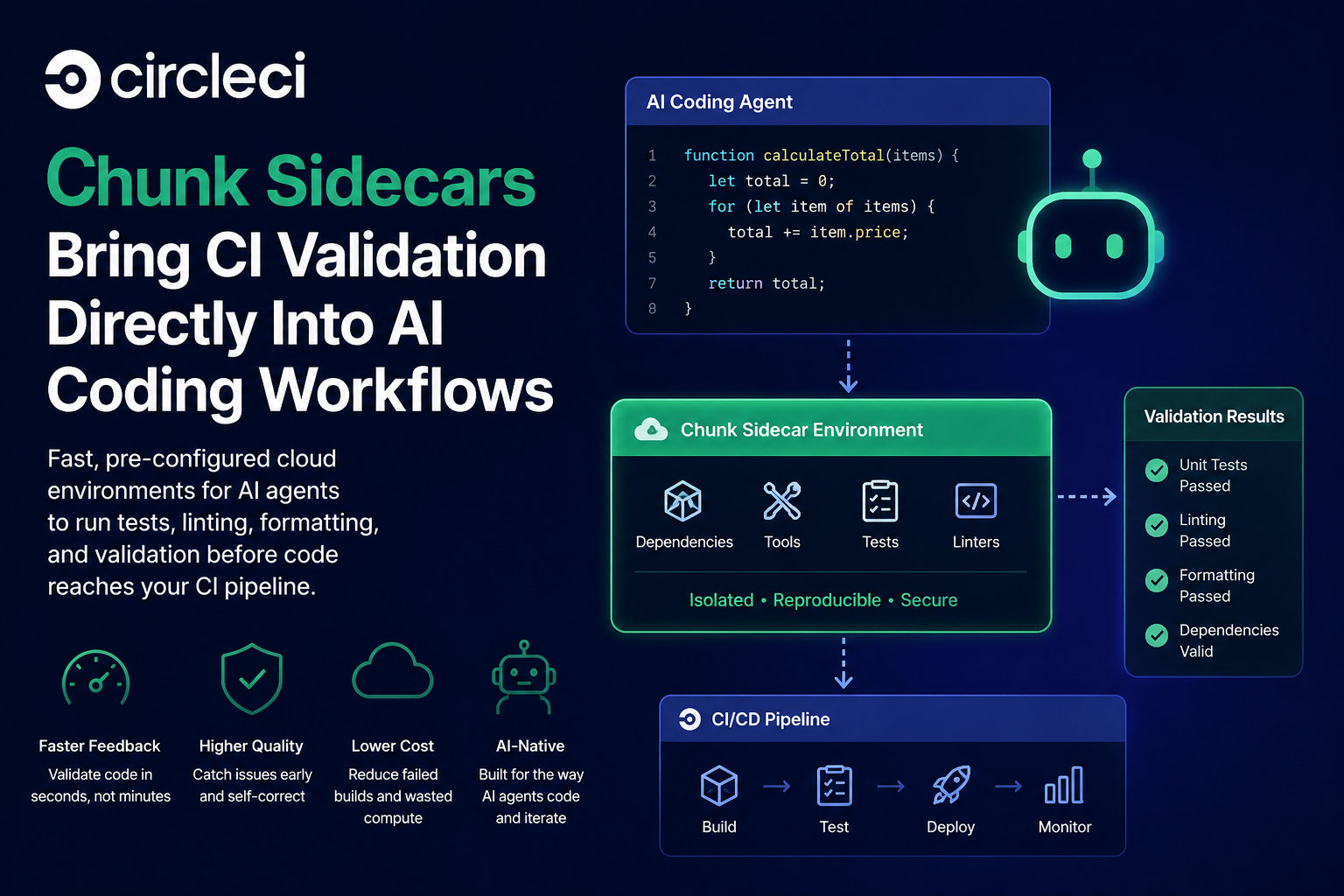
The new feature allows AI coding agents to run tests, formatting checks, linting, and validation tasks before code is committed to a repository. By moving quality checks closer to the moment code is created, CircleCI aims to solve one of the biggest challenges facing AI-powered software development: keeping code quality high while development speed continues to accelerate.
As AI coding tools become more common, software teams are generating code faster than ever. However, traditional validation processes often struggle to keep up, creating delays between code creation and feedback.
CircleCI Chunk Sidecars Move Validation Earlier
CircleCI Chunk Sidecars introduce what the company describes as “inner-loop validation.”
Instead of waiting for a full CI pipeline to run after code is committed, developers and AI agents can validate code instantly within lightweight cloud environments. These environments are pre-configured with project dependencies, testing frameworks, and development tools.
This allows AI agents to detect and fix problems while they still have full context of the code they are generating. The result is a faster feedback loop and fewer issues reaching production pipelines.
How CircleCI Chunk Sidecars Work
CircleCI Chunk Sidecars operate as reusable cloud-based development environments.
Teams can configure the environment once, create a snapshot, and reuse it across multiple coding sessions. Whenever an AI agent reaches a logical stopping point, automated validation processes can immediately run.
Because validation happens instantly, AI-generated code can be improved before it enters the main development workflow.
Why CircleCI Chunk Sidecars Matter for AI Development
CircleCI Chunk Sidecars address a growing bottleneck in software engineering.
While AI tools can produce code rapidly, deployment pipelines and quality controls have not advanced at the same pace. This often leads to more failed builds, additional debugging cycles, and increased infrastructure costs.
By enabling AI agents to self-correct earlier, organizations can reduce wasted compute resources and improve development efficiency.
The approach also increases the chances that pull requests pass downstream CI checks on the first attempt.
CircleCI Expands Its AI Strategy
CircleCI Chunk Sidecars are part of a broader push toward AI-driven software delivery.
The company has been expanding capabilities around its Chunk autonomous CI/CD agent, which can analyze pipeline performance, identify bottlenecks, and suggest optimizations.
With the addition of Sidecars, CircleCI is extending AI assistance beyond deployment pipelines and directly into the coding process itself. This transforms CI/CD from a passive verification system into an active participant in software development.
The Future of AI-Assisted Engineering
CircleCI Chunk Sidecars reflect a wider shift happening across the software industry.
Technology companies are increasingly building platforms that allow AI agents to work inside controlled environments where validation, testing, and governance are built into every step of development.
Industry leaders are investing heavily in tools that help AI-generated code meet enterprise standards before reaching production systems.
As agentic software development continues to evolve, validation and trust are becoming just as important as code generation itself.
CircleCI Chunk Sidecars represent a significant step toward that future, giving AI coding agents the ability to test, learn, and improve their work in real time while helping engineering teams maintain quality at scale.