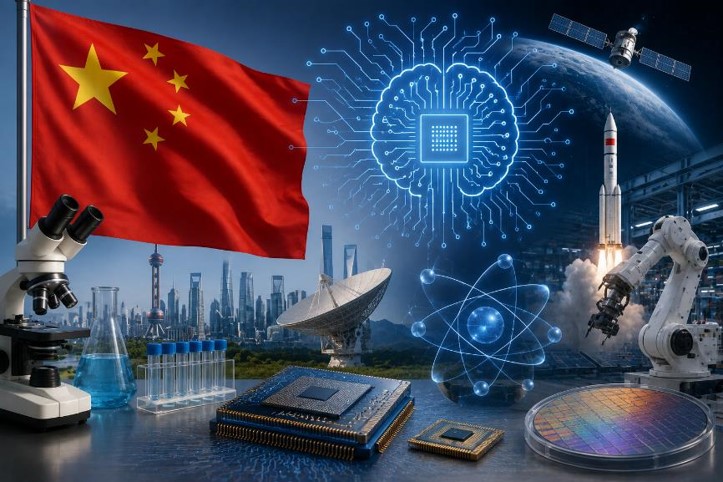
Artificial intelligence is developing at a remarkable pace, but concerns about its economic, social and technological impact are growing just as quickly. Now, China has pushed back against calls from some AI industry leaders to slow the development of increasingly powerful systems.
The Chinese government has described warnings about the need to slow AI progress as “fear mongering,” signaling that it does not see a broad pause in development as the right response to the challenges created by the technology.
China AI slowdown debate intensifies
The debate over a China AI slowdown comes as governments and technology companies around the world face difficult questions about how quickly artificial intelligence should advance.
Some AI executives and researchers have warned that the rapid race to build increasingly capable systems could create significant risks if development moves faster than safety measures, regulation and society’s ability to adapt.
China, however, appears to be taking a different approach. Rather than embracing a broad slowdown, officials have emphasized the importance of continued technological development and competition.
The response reflects the growing importance of AI to China’s ambitions in technology, industry and the wider economy.
Why are AI leaders calling for caution?
The calls for caution are not necessarily about stopping artificial intelligence altogether. Instead, many concerns focus on the speed and scale of AI development.
Advanced AI systems require enormous computing resources, large amounts of data and significant financial investment. At the same time, companies are competing to develop models that can perform increasingly complex tasks.
Critics worry that this race could make it difficult for researchers, governments and businesses to properly assess potential risks before new systems are widely deployed.
Issues such as misinformation, cybersecurity, job disruption, privacy and the reliability of AI-generated information have all become part of the wider conversation.
For some industry leaders, slowing down certain areas of development could provide more time to establish appropriate safeguards.
China wants to maintain AI momentum
China has invested heavily in artificial intelligence as part of its broader strategy to strengthen its technology sector and reduce dependence on foreign technologies.
The country has encouraged the development of domestic AI models, computing infrastructure and semiconductor technologies while supporting the adoption of AI across industries.
A significant slowdown could therefore have economic and strategic consequences.
For Chinese policymakers, the AI race is not simply about consumer applications. Artificial intelligence is increasingly viewed as an important technology for manufacturing, research, transportation, healthcare, finance and other sectors.
That makes continued AI development a major economic priority.
What does ‘fear mongering’ mean in this debate?
Calling warnings “fear mongering” suggests that officials believe some concerns about AI may be exaggerated or presented in ways that create unnecessary alarm.
The phrase does not mean that China is ignoring AI safety altogether. Governments and technology companies still face the challenge of making AI systems more reliable and managing their potential misuse.
Instead, the criticism appears to target arguments that development itself should be significantly slowed because of possible future dangers.
This distinction is important. The debate is increasingly shifting from whether AI should continue developing to how quickly it should advance and under what safeguards.
The global AI race is becoming more competitive
China’s position comes amid intense competition between major technology powers.
Companies in the United States, China and other countries are investing billions of dollars in AI research, data centers and specialized computer chips.
The competition has created a difficult balance for governments. Moving too slowly could mean falling behind technologically, while moving too quickly could increase the risks associated with powerful AI systems.
For businesses, the pressure is equally significant. Companies want access to better AI tools, but they also need to consider security, regulation, accuracy and the potential impact on employees.
What could a China AI slowdown mean for the industry?
A major China AI slowdown could affect the global technology industry because China is one of the world’s largest technology markets and a major center for research and manufacturing.
However, China’s rejection of a broad slowdown suggests that competition is likely to remain intense.
Continued investment could lead to faster advances in AI models, hardware and applications. It could also encourage companies to compete more aggressively on price, performance and efficiency.
At the same time, faster development could increase pressure on governments to establish clearer rules for AI safety and responsible use.
AI development is unlikely to slow dramatically
The disagreement highlights a broader reality: artificial intelligence has become too strategically important for major technology powers to easily step away from the race.
Instead of stopping development, governments are likely to focus increasingly on regulation, safety testing and responsible deployment.
For users and businesses, that means AI will probably continue becoming a larger part of everyday life.
The key question may no longer be whether AI development should continue, but whether innovation can move forward while governments and companies build adequate protections around it.
Conclusion
China’s rejection of calls for a China AI slowdown shows how strongly artificial intelligence has become tied to technological and economic competition.
While some AI leaders believe that a slower pace could provide more time to address potential risks, Chinese officials have characterized such arguments as “fear mongering.”
The debate is unlikely to disappear. As AI systems become more capable, countries will continue balancing innovation, competition and safety. The outcome could shape not only the technology industry but also the way businesses, governments and ordinary people use artificial intelligence in the years ahead.