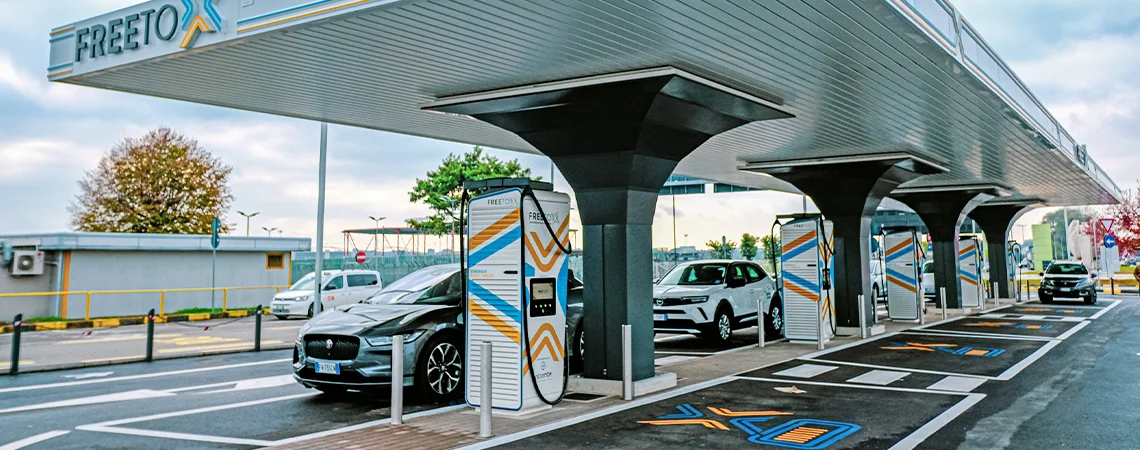
EU EV charging infrastructure is expanding faster than electric car sales in nearly every member state, easing fears that a shortage of public chargers could slow the switch to electric mobility.
New analysis from Transport & Environment, or T&E, shows that charging capacity is now ahead of electric vehicle demand across most of the European Union.
By the end of March 2026, every EU country except Malta had enough public charging capacity to meet the bloc’s fleet-based infrastructure target.
The findings suggest that Europe’s charging network is becoming better prepared for the next wave of electric vehicle growth.
However, the focus is now shifting from the number of chargers to reliability, pricing and ease of payment.
EU EV Charging Network Reaches 1.1 Million Points
The EU had about 1.1 million public charging points by the end of 2025.
That was five times the number available in 2020, showing how quickly charging infrastructure has expanded across the region.
The rollout has been supported by the Alternative Fuels Infrastructure Regulation, commonly known as AFIR.
The regulation requires EU member states to provide at least 1.3 kilowatts of publicly available charging power for every registered battery-electric vehicle.
It also requires at least 0.8 kilowatts for every registered plug-in hybrid vehicle.
When national targets are combined, the EU’s total charging capacity exceeds the required fleet-based level by about 180%, according to T&E.
This means charging infrastructure is currently growing faster than the electric vehicle fleet in almost every member state.
Why EU EV Charging Is Growing So Quickly
The rapid expansion reflects years of investment by governments, energy companies, automakers and private charging operators.
It also shows the impact of mandatory EU infrastructure rules.
AFIR became applicable in April 2024 and introduced binding national targets for public charging capacity, road coverage, payment options and price transparency.
The regulation was designed to prevent charging shortages as more drivers switch from petrol and diesel vehicles to electric models.
It also aims to make charging systems easier to use across national borders.
This is important because European drivers often travel between countries with different networks, apps and payment systems.
A stronger and more connected charging network could make long-distance EV travel easier while reducing concerns about running out of power.
Fast Chargers Expand Along Major EU Roads
EU EV charging growth is also becoming more visible along the region’s busiest roads.
AFIR requires high-powered charging stations along the Trans-European Transport Network, known as TEN-T.
The rules cover the EU’s main motorways, regional highways and important transport corridors.
Under the distance-based target, charging stations with at least 150 kilowatts of capacity must be available at regular intervals of no more than 60 kilometers along major routes.
By June 2026, about 79% of the TEN-T Core Network had met the EU’s 2025 target for ultra-fast charging coverage.
The Core Network mainly includes the bloc’s most important national motorways and cross-border transport routes.
Progress has also been strong on the wider TEN-T Comprehensive Network, which includes regional motorways and primary roads.
T&E found that 20 of the EU’s 27 member states had already reached the 2027 charging target for this network, about 18 months ahead of schedule.
Spain and Eastern Europe Still Have Charging Gaps
Despite the overall progress, public charging coverage remains uneven.
Some of the largest gaps are in Spain and several Eastern European countries.
These regions have fewer high-powered charging stations along certain long-distance routes.
However, T&E said many of the countries with coverage gaps are also recording some of the fastest growth in ultra-fast charger installations.
This suggests that the difference between stronger and weaker charging markets could narrow as new stations open.
Only 70 Strategic Stations Could Transform Coverage
Closing the remaining gaps may not require a massive expansion.
T&E estimates that installing or upgrading only 70 strategically located stations could increase compliance with the EU’s 60-kilometer charging target to about 90%.
Spain would need the largest number, with 22 additional stations.
Poland would require 11, while Romania would need seven.
The remaining stations would be spread across other areas where gaps still exist.
These relatively limited investments could make cross-border and long-distance electric travel easier across much of Europe.
EU EV Charging Eases Range Anxiety
A lack of public charging has long been one of the main concerns raised by potential electric car buyers.
Drivers often worry that they will struggle to find a working charger during long journeys or in unfamiliar areas.
The latest figures suggest that charger availability is becoming less of a barrier in the EU.
In many countries, charging capacity is already growing faster than the number of electric cars using the network.
This could help reduce range anxiety and encourage more drivers to consider buying an electric vehicle.
It could also support automakers as they introduce more affordable electric models to the European market.
Apartment Residents Still Depend on Public Chargers
Public charging remains particularly important for people who cannot install a charger at home.
Drivers living in apartments, rented properties or buildings without private parking often depend on public stations for most of their charging needs.
For these users, the quality of the network matters as much as the number of chargers.
A station may appear on a map but still be difficult to use because it is broken, occupied or linked to an unfamiliar payment system.
Public charging must therefore become more dependable as electric car ownership grows.
Reliability and Pricing Become the Next Challenge
The rapid expansion of EU EV charging infrastructure does not mean every problem has been solved.
T&E said the next challenge is improving the experience for drivers.
Charging stations must be reliable and easy to locate. Prices must also be clearly displayed before a charging session begins.
Drivers should be able to pay using simple methods without being forced to download several apps or create multiple accounts.
The European Commission says AFIR includes requirements covering payment options, consumer information, price transparency and non-discriminatory access.
These rules could help create a more consistent experience across different countries and charging providers.
Better Charging Could Accelerate EV Adoption
A convenient public charging network can influence whether drivers feel confident enough to buy an electric vehicle.
When chargers are widely available, reliable and easy to use, switching away from petrol or diesel becomes less disruptive.
Businesses may also be more willing to electrify company fleets when dependable charging is available along major transport routes.
The growth of high-powered stations could be especially important for drivers who travel long distances and need short charging stops.
Faster chargers can restore a significant amount of battery range within minutes, although actual charging speed depends on the vehicle, battery condition and station capacity.
Europe Shifts Focus From Quantity to Quality
The EU appears to have made major progress in expanding public charging ahead of future electric vehicle demand.
Nearly every member state has reached the fleet-based charging target, while many countries are already ahead of deadlines for fast-charging coverage.
The next stage will be less about simply adding more chargers and more about improving the quality of the service.
Drivers will expect stations that work consistently, accept straightforward payments and offer clear prices.
For Europe’s electric vehicle transition, that shift could be crucial.
The EU EV charging network may already be large enough to support continued growth. The challenge now is making sure every charging session is simple, reliable and affordable.