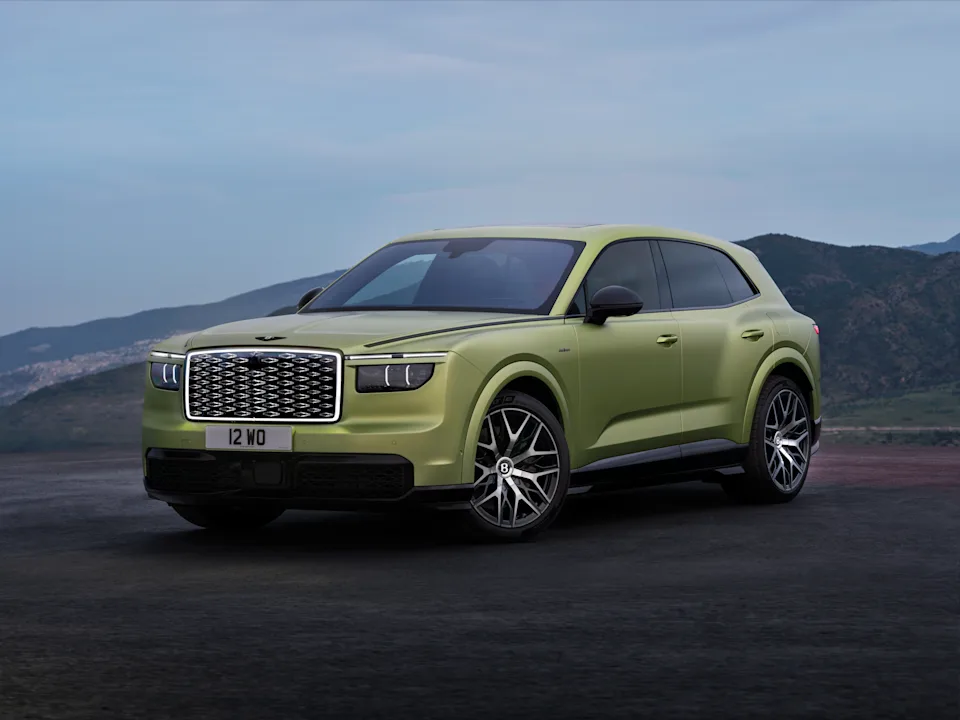
The Bentley Torcal EV has officially arrived, marking one of the biggest changes in the British luxury carmaker’s modern history as it launches its first fully electric production vehicle.
Bentley unveiled the Torcal on September 23, 2026, positioning the new SUV as a distinctly Bentley interpretation of an electric car rather than an attempt to reinvent the company for the battery-powered age.
That approach comes at an interesting moment for the luxury automotive industry. Several high-end manufacturers have become more cautious about the speed of the electric transition as demand among wealthy buyers has proved harder to predict than many carmakers expected.
Rather than retreating completely, Bentley is taking a more measured approach: launch one important electric model, continue selling hybrids and see how customers respond.
Bentley Torcal EV becomes the brand’s first electric car
The Bentley Torcal EV is a luxury SUV and a completely new model line rather than an electric version of an existing Bentayga, Continental GT or Flying Spur.
Its arrival gives Bentley four main product families and opens a new chapter for a company whose identity has historically been built around large petrol engines, effortless power and handcrafted interiors.
Bentley has worked hard to make sure the Torcal still looks familiar.
While electric cars do not require the same cooling grille as combustion-powered vehicles, the Torcal uses diamond-shaped lighting elements at the front to create a visual connection with the traditional Bentley grille.
Bentley CEO Frank-Steffen Walliser told Reuters that the company’s priority was to create a Bentley first rather than simply designing something that looked radically different because it happened to be electric.
That philosophy runs through much of the car.
Instead of treating electrification as a reason to abandon Bentley’s heritage, the company appears to be using new technology to reinterpret it.
Bentley Torcal EV even recreates the character of a V8
One of the Torcal’s more unusual features is its sound.
Electric motors are naturally far quieter than the large combustion engines traditionally associated with Bentley. The company therefore developed an artificial driving soundtrack intended to give the Torcal more character.
Reuters reports that the sound is based on orchestral timpani, or kettledrums, combined with smaller drums whose tempo increases as the driver accelerates. The idea is to reproduce some of the emotional feedback normally associated with a powerful V8 without simply playing a recording of an engine through the speakers.
It might sound unusual, but it highlights one of the biggest challenges facing luxury performance brands.
An electric motor can easily provide enormous power and instant acceleration. Replacing the noise, vibration and mechanical personality that buyers associate with expensive performance cars is more complicated.
Bentley is clearly trying to solve that problem without making the Torcal feel artificial or disconnected from the rest of its range.
A relatively affordable way into Bentley ownership
Luxury is relative, particularly in the Bentley world.
The Torcal starts at around £173,000, which hardly makes it inexpensive. However, it places the electric SUV towards the lower end of Bentley’s range and far below some ultra-exclusive electric rivals.
Reuters notes that Ferrari’s first electric model, the Luce, starts at €550,000.
Walliser described the Torcal as a more affordable Bentley that could help the company reach new buyers.
That strategy may be important.
Bentley says roughly half of the early interest it has seen comes from existing customers, while the other half comes from people who are new to the brand. Early interest has been particularly strong in Europe, the Middle East and parts of the United States where electric vehicles have achieved higher adoption.
In other words, Bentley is not relying entirely on its traditional customer base to make the Torcal work.
Bentley Torcal EV promises serious long-distance ability
Range is particularly important for a luxury vehicle.
Bentley customers are unlikely to accept an expensive SUV that feels compromised during long-distance journeys, and the company has therefore focused heavily on making its first EV usable beyond city driving.
The Torcal is expected to offer around 375 miles of driving range on a full charge, placing it among the longer-range electric luxury vehicles currently reaching the market.
That fits with Bentley’s earlier description of the vehicle as a “luxury urban SUV.”
The word urban does not mean the Torcal is intended purely for short journeys around London, Dubai or Los Angeles. Bentley wants the vehicle to remain comfortable and capable on long-distance trips while being slightly more manageable in busy cities than some of its larger models.
£350 million investment backs Bentley’s electric future
The Torcal represents more than a new vehicle.
Bentley says it has invested around £350 million in its historic Crewe factory in northwest England to prepare for production of the electric SUV.
The investment is important because every Bentley continues to be developed and built around the company’s Crewe headquarters.
Bentley has described its evolving manufacturing operation as a “Dream Factory,” with new digital production systems, updated facilities and infrastructure designed to support electric vehicles alongside increasingly electrified versions of its traditional models.
The company is therefore electrifying without abandoning the British manufacturing base that remains central to its identity.
Luxury rivals are becoming more cautious about EVs
What makes the Bentley Torcal EV particularly interesting is the timing of its arrival.
Only a few years ago, major luxury manufacturers were announcing aggressive timelines for moving almost entirely to electric vehicles.
The market has since become more complicated.
Bentley itself previously intended to become a fully electric brand by 2030. It later abandoned that deadline after concluding that customers were not shifting towards EVs as quickly as expected.
The company initially pushed the target back to 2035 while extending the life of plug-in hybrid models.
More recently, Bentley has become even more flexible about its long-term powertrain strategy rather than committing itself to a rigid date on which combustion engines will disappear.
Bentley is far from alone.
Lamborghini delays its first EV
Lamborghini, another Volkswagen Group luxury brand, has delayed the introduction of its first fully electric model until around the end of the decade.
The Italian manufacturer has instead concentrated heavily on hybridising its range.
Reuters reported that limited customer demand was among the reasons behind Lamborghini’s more cautious timetable.
That illustrates an important difference between the mainstream and ultra-luxury car markets.
Customers spending several hundred thousand dollars on a vehicle are not necessarily motivated by the same factors as buyers shopping for an ordinary family EV. Sound, engine character, rarity and emotional appeal can carry greater importance.
McLaren is not rushing into electric cars either
British supercar manufacturer McLaren has taken an even more cautious position.
The company said it currently has no plans to launch a fully electric vehicle, again pointing to insufficient customer demand.
That does not mean McLaren will never produce an EV.
Instead, it demonstrates how luxury manufacturers are increasingly avoiding fixed electric deadlines when they cannot be certain that their customers are ready.
For small-volume manufacturers, getting that timing wrong can be extremely expensive.
Rolls-Royce also backs away from an all-electric deadline
Rolls-Royce has already entered the electric market with the Spectre coupe, making it one of the few ultra-luxury manufacturers with a battery-electric car available to customers.
But even Rolls-Royce has become more flexible.
Earlier in 2026, the BMW-owned company dropped its previous goal of becoming completely electric by 2030.
CEO Chris Brownridge said changing regulations and customer demand meant some buyers still wanted the company’s traditional V12-powered cars.
The Spectre remains part of the company’s range, but Rolls-Royce is no longer treating electrification as an all-or-nothing transition on a fixed deadline.
Porsche offers another warning about the EV transition
Bentley’s Volkswagen Group stablemate Porsche has also faced difficulties.
Porsche previously slowed parts of its electric vehicle rollout after demand failed to match earlier expectations, particularly as the company faced pressure in China and the United States.
The consequences have been expensive.
Porsche’s struggles have contributed to significant financial pressure on parent company Volkswagen, which recently recorded multibillion-euro writedowns related to the sports-car manufacturer.
For Bentley, those experiences provide a useful warning.
Launching electric cars is not simply about producing technologically impressive vehicles. Carmakers also need enough customers willing to buy them at prices that maintain the margins expected from luxury brands.
Hybrids remain important to Bentley
That helps explain why Bentley is not abandoning combustion engines overnight.
The Continental GT, Continental GTC and Flying Spur have increasingly moved towards plug-in hybrid powertrains, combining electric motors with powerful petrol engines.
Bentley ended production of its famous W12 engine in 2024, but that did not mean the immediate end of combustion power across the brand.
Instead, plug-in hybrids are becoming an important bridge between traditional Bentleys and pure electric models.
The strategy gives customers a choice while allowing Bentley to learn from how Torcal buyers actually use an electric luxury vehicle.
The Bentley Torcal EV is also a test of wealthy buyers
That may ultimately be the most important role of the Torcal.
The car is not simply Bentley’s first EV. It is effectively a real-world test of how much its customers actually want electric propulsion.
For years, luxury manufacturers could confidently announce future EV targets because governments were tightening emissions rules and battery technology was advancing rapidly.
Consumer behaviour has proved less predictable.
Some wealthy buyers enthusiastically embrace electric cars, particularly for their smoothness, silence and instant acceleration.
Others continue to value large combustion engines as an important part of what makes an expensive performance car special.
The Torcal attempts to sit between those two groups.
It offers electric technology without asking customers to give up the visual character, craftsmanship or driving personality traditionally associated with Bentley.
A more flexible electric future
The launch of the Bentley Torcal EV does not mean Bentley has returned to the aggressive electric timetable it once envisioned.
If anything, it represents a more cautious version of electrification.
Reuters reported that Bentley currently has no immediate plan for a second EV launch, while the company continues developing hybrid vehicles and responding to changes in customer demand.
That makes the Torcal unusually important.
If it succeeds, Bentley will have evidence that its customers are ready for more electric models. If demand proves weaker, the company’s flexible strategy gives it room to continue leaning on hybrids for longer.
Either way, Bentley has finally crossed a line that once seemed almost unthinkable for a marque built around enormous engines.
Its first fully electric car is here.
But rather than declaring the combustion era over, Bentley is entering the electric age one carefully measured step at a time.