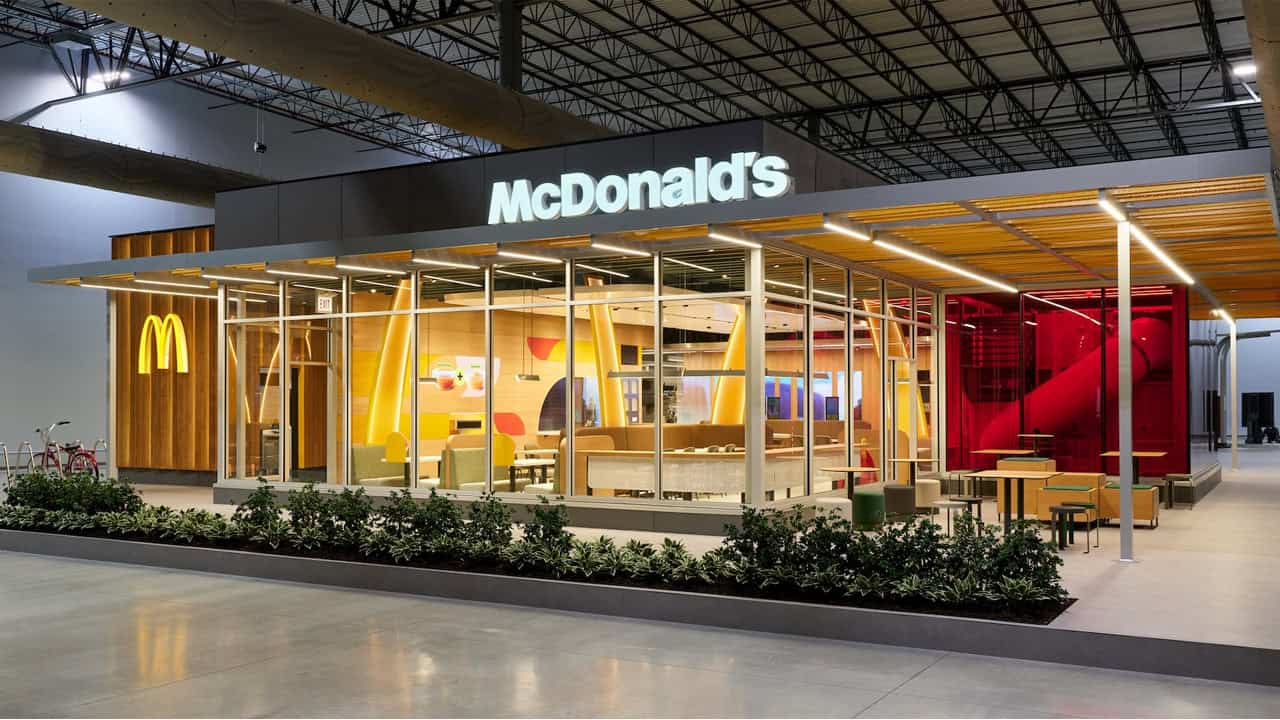
McDonald’s restaurant makeover is about much more than giving its stores a fresh coat of paint. The fast-food giant is preparing a sweeping transformation that will change how its restaurants look, how kitchens operate and even what customers see on the menu.
McDonald’s announced on September 23 that it plans to provide around $8.5 billion in support through 2036 as part of its new NEXT strategy. The money will help franchisees modernize restaurants, install new technology and improve operations across its enormous global network. Around $5 billion of that support is expected to be provided by the end of 2030.
Behind the investment is a simple challenge. Fast-food customer traffic has been relatively flat in several major markets, including the United States, leaving McDonald’s looking for ways to attract more visits while making each restaurant faster and more efficient.
The answer, according to McDonald’s, will involve everything from artificial intelligence to chicken, coffee and meals designed for people looking for more protein.
McDonald’s restaurant makeover goes beyond new interiors
Customers will notice some of the changes immediately.
McDonald’s plans to introduce restaurant features such as dedicated lockers for delivery and pickup orders, redesigned kitchens and more visible coffee preparation areas. Some locations could also receive larger children’s play areas.
The idea is to make restaurants better suited to how customers now use McDonald’s.
A growing share of orders arrives through mobile apps, delivery services, kiosks and drive-thrus rather than the traditional counter. A restaurant layout designed decades ago may therefore struggle with the flow of modern digital orders.
The NEXT strategy aims to address that.
Instead of forcing employees to work around older layouts, McDonald’s wants kitchens and customer areas designed around today’s ordering habits.
AI becomes a bigger part of McDonald’s restaurants
Technology is one of the most important parts of the McDonald’s restaurant makeover.
At the centre of the plan is ArchIQ, an AI-enabled restaurant operating system that McDonald’s says can simplify restaurant operations and improve efficiency.
ArchIQ will help automate routine tasks such as inventory management and employee scheduling while supporting more accurate restaurant operations. McDonald’s developed parts of its broader restaurant technology infrastructure with Google.
The company is also working on an AI-powered ordering system known as Archy.
The system can take drive-thru orders in both English and Spanish and has reached an accuracy rate of about 90%, according to information presented during McDonald’s investor event.
For customers, that could eventually mean shorter waits and fewer mistakes.
For restaurant employees, McDonald’s believes automation could reduce the amount of time spent on repetitive administrative work.
Chief Financial Officer Ian Borden said Archy could eventually save at least 50 labour hours per week at a typical restaurant. The company says the goal is not simply to cut staffing, but to allow workers to spend more time preparing food and serving customers.
Smarter kitchens could catch missing items
Artificial intelligence will not be limited to taking orders.
McDonald’s is also expanding the use of accuracy scales in its restaurants.
These systems check the expected weight of completed orders and can alert workers when something may be missing before the bag reaches the customer.
The technology is already being used in roughly 10,000 restaurants worldwide. McDonald’s plans to increase that number to around 20,000 restaurants by 2028.
It may sound like a small change, but order accuracy matters enormously for a company serving millions of customers every day.
A forgotten portion of fries or missing burger can turn a quick meal into a frustrating experience, particularly for delivery customers who cannot simply walk back to the counter.
McDonald’s restaurant makeover targets efficiency
There is also a financial reason behind all this technology.
McDonald’s expects the NEXT programme to generate around 250 basis points of gross restaurant-level efficiency improvements.
For an average U.S. restaurant, the company says that could be equivalent to roughly $100,000 in annual cash-flow benefits, with much of the benefit eventually flowing to the restaurant’s bottom line.
That matters because most McDonald’s restaurants are operated by franchisees.
Major restaurant upgrades can be expensive, and franchise owners must be convinced that improvements will eventually generate enough additional business or savings to justify the cost.
McDonald’s estimates that participating franchisees could see an approximately four-year payback after company support is taken into account.
The company plans to provide that support through a mixture of capital assistance and rent relief.
Protein is becoming a bigger menu priority
The technology story may attract attention, but another major change is happening on the menu.
McDonald’s sees growing demand for meals containing more protein.
The company has already started highlighting protein information more prominently. In April, McDonald’s introduced protein badges across its kiosks and mobile app for 17 menu items.
It says more than 30 existing menu products contain at least 15 grams of protein. An Egg McMuffin, for example, contains 17 grams, while a 10-piece Chicken McNuggets order provides 23 grams.
But McDonald’s intends to go beyond simply putting labels on existing meals.
The company is exploring products such as egg bites and bowls while preparing additional chicken options, including grilled chicken sandwiches and wraps.
That could gradually make the McDonald’s menu look different from the burger-and-fries image many customers still associate with the brand.
GLP-1 users are changing what restaurants think about food
One reason behind the protein push is the rapid growth of GLP-1 weight-management medicines in the United States.
People using these medicines often eat smaller portions, which has forced food and restaurant businesses to think more carefully about what those customers may want from a meal.
McDonald’s USA President Skye Anderson said around 30 million Americans are using GLP-1 medicines, while company research suggests approximately 60 million Americans are actively trying to consume more protein.
That creates an interesting opportunity for the chain.
Rather than depending entirely on bigger portions, McDonald’s can offer smaller meals built around protein and convenience.
Egg bites, bowls, chicken products and clearly labelled protein content could help McDonald’s appeal to customers whose eating habits are changing.
At the same time, the protein strategy reaches far beyond people using GLP-1 medicines. Fitness trends and changing nutrition preferences have made protein one of the most heavily marketed food attributes across supermarkets and restaurants.
Chicken is becoming increasingly important to McDonald’s
Chicken will also play a major role in McDonald’s next growth phase.
The company wants to gain 1.5 percentage points of market share in both chicken and beverages by 2030 while maintaining its leadership position in beef.
That explains why customers are likely to see more chicken products appearing alongside traditional favourites such as the Big Mac and Quarter Pounder.
New concepts under consideration include hand-breaded chicken products as well as grilled chicken sandwiches and wraps.
Chicken gives McDonald’s room to compete for occasions where customers may not necessarily want a burger.
It also places the company into even stronger competition with chains that have built much of their identity around chicken.
Coffee and beverages are another battleground
McDonald’s does not want the restaurant makeover to focus entirely on food.
Beverages are another major target.
More visible coffee preparation areas are among the design ideas being considered as the company tries to strengthen customers’ perception of its coffee quality.
That may seem like a small design detail, but it reflects a broader ambition.
Coffee can bring customers into restaurants outside traditional lunch and dinner hours, while speciality drinks can carry attractive margins.
McDonald’s therefore sees beverages as an important growth category rather than simply something customers order alongside a burger.
Workers will also be part of the transformation
Technology alone cannot deliver the experience McDonald’s wants.
The company is pairing Restaurant > NEXT with People > NEXT, an initiative designed to improve hospitality and give employees additional training.
McDonald’s is also launching a multi-year programme called Make It Golden, which is intended to bring restaurants around the world behind a more consistent approach to food quality and customer service.
The programme begins around McDonald’s Founder’s Day on October 5.
That human element could prove important.
Customers may appreciate faster digital ordering, but their experience still depends heavily on the employees preparing meals, solving problems and keeping restaurants running smoothly.
McDonald’s is trying to reinvent the restaurant without losing what works
The scale of this transformation makes it significant.
McDonald’s is not abandoning burgers, fries or the Golden Arches. Instead, it is trying to build a more modern business around the products and brand recognition it already has.
Restaurants will become increasingly digital. Kitchens will use more automation. AI will handle more routine tasks. Menus will put greater emphasis on chicken and protein. Store designs will increasingly accommodate delivery, mobile ordering and changing customer expectations.
McDonald’s believes those changes can produce both better customer experiences and stronger restaurant economics.
Its ultimate target is ambitious: the company wants its operating margin to reach the low-to-mid 50% range by 2030 while increasing its share of important categories such as chicken and beverages.
The $8.5 billion bet is really about McDonald’s next decade
The McDonald’s restaurant makeover shows how dramatically the fast-food business is changing.
Customers still want affordable, convenient meals, but convenience now means much more than having a drive-thru window. People expect reliable mobile ordering, quick delivery, personalised digital experiences and fewer mistakes.
At the same time, eating habits are evolving.
Protein has become a bigger priority for millions of consumers, while GLP-1 medicines are influencing portion sizes and the kinds of foods some customers choose.
McDonald’s is trying to respond to all of those changes at once.
Its $8.5 billion NEXT commitment therefore represents something bigger than a restaurant renovation programme. It is a bet that artificial intelligence, smarter kitchens, redesigned restaurants and a broader menu can keep the Golden Arches relevant to another generation of customers.