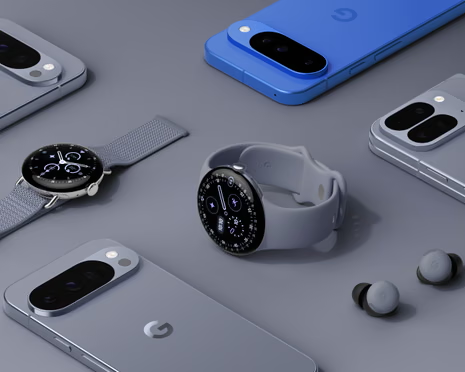
Google is making an unusual argument in the smartphone industry’s race to build the most powerful artificial intelligence features: perhaps the smartest phone is the one that demands less of your attention.
The latest Google Pixel AI positioning turns one of the technology industry’s biggest assumptions on its head. Instead of measuring intelligence by how many minutes people spend interacting with their screens, Google’s challenger-brand message suggests that great technology should complete tasks quickly, surface useful information at the right moment and then get out of the way.
The idea can be summarized by a striking proposition: “The smartest phone lets you look away from it.”
It arrives as Google pushes its newly announced Pixel 11 family deeper into AI, with Gemini-powered features designed to anticipate information, reduce repetitive interactions and help users accomplish tasks with fewer steps. Google unveiled the Pixel 11 lineup on August 12, 2026, with devices scheduled to begin shipping on August 20.
Google Pixel AI Challenges the Attention Economy
Smartphones have spent years competing for attention.
Bigger displays, brighter screens, more apps, endless notifications and social platforms have made the phone one of the most frequently used objects in everyday life.
Google’s latest positioning suggests a different definition of technological progress.
Rather than asking consumers to spend more time navigating apps, Google Pixel AI is increasingly designed around reducing the number of interactions required to get something done.
That could mean automatically surfacing information before a user searches for it, handling tasks through Gemini or communicating information without requiring someone to repeatedly unlock the phone.
It gives Pixel an interesting marketing identity at a time when most flagship smartphones are becoming increasingly similar in physical design.
Google is effectively arguing that the next smartphone battle will not only be about what a phone can do.
It will also be about how little effort the owner needs to make it do it.
Pixel 11 Puts AI at the Center of Google’s Strategy
The new Pixel 11 series includes the Pixel 11, Pixel 11 Pro, Pixel 11 Pro XL and Pixel 11 Pro Fold.
Google has again placed artificial intelligence at the heart of the lineup rather than relying solely on traditional hardware upgrades. Features across the new devices include deeper Gemini integration, real-time media translation, AI-assisted photography and tools intended to provide more proactive assistance.
The approach builds on a strategy Google has been developing for several generations.
Pixel phones have increasingly become showcases for what Google believes Android can become when its software, AI models and custom hardware are designed together.
The Pixel 11 series continues that direction with Google’s Tensor G6 processor and an expanded collection of AI-powered experiences.
Rather than presenting AI simply as another application users open, Google wants intelligence to become part of how the phone works in the background.
That distinction matters.
The most useful AI may eventually be technology consumers barely notice.
Google Wants Pixel to Anticipate What Users Need
One of the strongest examples of Google’s philosophy is proactive assistance.
Instead of requiring someone to open several applications, search for information and manually move it between services, AI can increasingly understand context and present useful information when it becomes relevant.
Google had already moved in this direction with Pixel 10’s Magic Cue, which could surface contextual information from a user’s phone when it was needed. For example, Google described the system as capable of finding relevant information from Calendar during a conversation without forcing the user to switch between apps.
The broader objective is simple: fewer taps.
A truly intelligent smartphone should understand enough context to remove unnecessary steps rather than creating another layer of technology the user has to manage.
That helps explain why the “look away” idea works particularly well for Pixel.
It transforms AI from something designed to capture attention into something designed to return attention to the user.
HiLight Shows How Google Pixel AI Can Work Without a Screen
The Pixel 11 also introduces an interesting hardware feature that fits neatly into this philosophy.
Google calls it HiLight.
On Pixel 11 Pro models, the system uses a colored LED ring around the camera flash to provide information even when someone is not actively looking at the display. Users can associate different colors with contacts, allowing certain notifications to be recognized while the phone is face-down.
It sounds like a relatively small addition compared with a new processor or camera sensor.
Strategically, however, it represents something larger.
For years, notifications have encouraged users to pick up their phones.
A light that communicates enough information without requiring someone to unlock the device creates the opposite behavior.
You can understand what is happening and decide whether it deserves your attention.
That is exactly the kind of interaction Google’s new Pixel positioning appears designed to promote.
The Smartphone Industry Has an Attention Problem
The message also taps into a wider cultural concern surrounding smartphones.
People increasingly recognize the strange contradiction at the heart of modern mobile technology.
Phones are supposed to save time.
Yet the same devices can consume enormous amounts of it.
Every useful tool sits beside notifications, entertainment, messages, social feeds and applications competing to keep users engaged.
That creates an opening for a technology company willing to argue that less screen time can actually demonstrate better technology.
Google’s strategy does not mean Pixel phones are becoming minimalist devices.
Quite the opposite.
The Pixel 11 series remains packed with advanced cameras, high-end displays and sophisticated AI capabilities. Google has added features including Magic Capture, enhanced zoom capabilities and upgraded photography tools across the lineup.
The difference is in how those technologies are being framed.
Google is suggesting that intelligence should reduce complexity rather than add to it.
Google Pixel AI Gives the Brand a Challenger Identity
Pixel remains much smaller globally than smartphone giants such as Apple and Samsung.
That position can be a disadvantage in distribution and market share, but it also gives Google more freedom to present Pixel as a challenger rather than simply another established smartphone brand.
Analysts have long viewed Pixel partly as Google’s demonstration of what an AI-focused Android phone can be. Despite its comparatively modest global market position, Pixel has gained ground in markets including the United States, United Kingdom and Japan.
Google’s marketing has increasingly leaned into that outsider identity.
Ahead of the Pixel 11 launch, the company continued its “Ask more of your phone” campaign, emphasizing the advantage of combining Google’s own services—including Search, Gmail, Maps, Photos, Drive and Gemini—with Pixel hardware.
That provides Google with a relatively simple argument.
Consumers already rely heavily on Google services.
Pixel is the phone designed by the same company.
The latest campaign appears to add another layer: if Google’s software already understands so much of what people are trying to accomplish, the phone should require less active management.
AI Could Make Smartphones Feel Less Like Apps
For much of the smartphone era, using a phone has meant using apps.
Want directions? Open Maps.
Need an email? Open Gmail.
Want to schedule something? Open Calendar.
Need information? Open Search.
AI potentially changes that model.
A user could simply describe what they want while the intelligence underneath the operating system works across multiple services.
Google has already demonstrated this concept with Gemini, which can perform actions involving different Google apps from a single request.
If that model becomes reliable enough, smartphones could gradually become less application-centered.
People would spend less time navigating software interfaces and more time simply telling their devices what they need.
That could ultimately be the most important meaning behind Google’s claim that the smartest phone allows you to look away.
The screen does not disappear.
It just stops being the center of every interaction.
Google Is Selling AI as Convenience, Not Just Power
The smartphone industry’s early AI marketing focused heavily on capability.
Phones could generate images.
They could summarize documents.
They could rewrite messages.
They could remove unwanted objects from photographs.
Those demonstrations helped establish what generative AI could do, but many consumers still face a simpler question: How does this make my day easier?
Google’s Pixel strategy is increasingly trying to answer that question.
Instead of presenting AI only as spectacular technology, Google can position it as something that quietly removes inconvenience.
A phone remembers.
A phone understands context.
A phone surfaces information.
A phone handles several steps at once.
Then the user moves on.
That could prove much easier for ordinary consumers to understand than benchmarks or technical discussions about AI models.
The Smartest Phone May Be the One You Notice Least
Google’s newest Pixel philosophy points toward an interesting future for smartphones.
For years, technology companies worked to make phones more engaging.
Artificial intelligence could eventually make the best phones less demanding.
The real measure of intelligence may not be how many features manufacturers can fit into a device, but how effectively those features disappear into everyday life.
That is why the Google Pixel AI message is more significant than a clever advertising line.
It gives Google’s smartphone business a clear purpose.
Apple can emphasize its ecosystem. Samsung can emphasize its enormous hardware range. Google can increasingly position Pixel around intelligence that understands what users need before they spend several minutes searching for it.
The Pixel 11 still wants to be one of the most advanced smartphones available.
But Google’s challenger-brand pitch introduces a compelling twist.
The smartest technology may not be the technology that keeps your eyes glued to the screen.
It may be the technology that handles what you need—and gives you a reason to put the phone back down.