Mining is entering a new technological era, and Huawei intelligent mining solutions are at the center of this transformation. By combining artificial intelligence with advanced connectivity technologies such as 5G, private LTE and optical networks, Huawei aims to help mining companies build smarter, safer and more sustainable operations.
Speaking at the Mobile World Congress in Barcelona, Andy Wu, President of Huawei’s Mining Business Unit, said the company is focused on enabling the next phase of mining evolution. According to Wu, the industry is moving beyond automation toward fully intelligent mining systems powered by data and AI.
Huawei intelligent mining supports next generation operations
Huawei intelligent mining technology is designed to transform traditional mining processes into digitally connected operations. The company’s systems allow mining sites to connect machines, workers and monitoring systems through high-speed networks.
Low-latency connectivity makes it possible to automate complex activities such as blasting, loading and haulage. In some cases, mining companies can even operate underground sites without personnel physically present.
Wu explained that the industry has already progressed from manual mining to mechanised and partially automated operations. However, the next stage will involve intelligent decision-making supported by artificial intelligence.
Huawei intelligent mining success in China
Much of Huawei’s progress in intelligent mining has been developed in China, where strict safety and productivity regulations pushed companies to adopt digital technologies earlier.
Huawei began working with coal mining operations more than a decade ago to create connectivity systems capable of supporting worker positioning, equipment tracking and safety monitoring.
According to Wu, Huawei has helped modernise nearly 80 percent of China’s underground coal mining sector through digital connectivity solutions.
These innovations allowed mines to improve operational efficiency while meeting regulatory requirements more quickly.
Huawei intelligent mining powers autonomous truck fleets
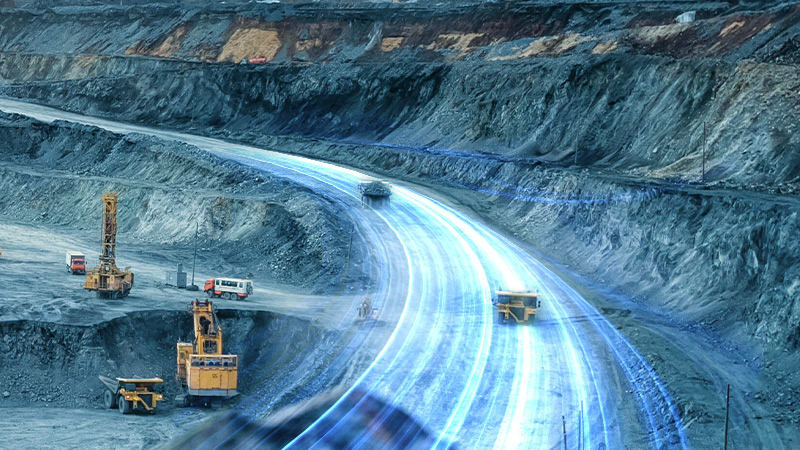
One of the most advanced examples of Huawei intelligent mining technology can be found at the Yimin open-pit coal mine in Inner Mongolia.
In partnership with Huaneng Mengdong Company, Huawei helped launch the world’s first commercial fleet of 100 autonomous electric mining trucks.
The system relies on Huawei Cloud algorithms to support autonomous driving in open-pit mining operations. Artificial intelligence processes data from sensors and cameras to guide the vehicles and coordinate fleet movements.
The mine also uses a 5G-Advanced network to maintain stable connectivity across the site. This network supports high-definition video transmission and real-time communication between trucks and cloud-based dispatch systems.
The electric trucks are expected to reduce carbon dioxide emissions by around 48,000 tonnes each year.
Huawei intelligent mining enables connected underground networks
Huawei is also expanding intelligent mining systems underground. At several mines in China, the company has developed advanced connectivity networks that support multiple digital applications simultaneously.
One example is the Lilou coal mine operated by Shandong Energy. Huawei helped create an industrial ring network based on SRv6 and FlexE technologies.
This system allows production control, video monitoring and safety systems to operate on a single unified network.
The network also improves reliability and reduces troubleshooting time by approximately 50 percent through intelligent monitoring and automated maintenance tools.
Huawei intelligent mining expands globally
Although many of Huawei’s early projects began in China, the company is now expanding its mining technologies internationally.
Huawei’s flexible network solutions are gaining attention in regions such as Africa, Latin America and Central Asia. One example is the company’s “Cell on Wheels” system.
This portable mobile base station can be transported to remote mining sites and quickly deployed to create temporary 5G coverage. The system includes antennas, power sources and telescopic masts that can deliver connectivity even in isolated areas.
Huawei has also tested a solar-powered version of the system at an African mine, demonstrating how renewable energy can support digital infrastructure in remote locations.
Huawei intelligent mining integrates full site connectivity
A major advantage of Huawei intelligent mining technology is its ability to integrate all communications across a mining operation.
Through its F5G fixed network architecture, Huawei provides fibre-based communication systems that support multiple technologies within a single infrastructure.
These networks can include WiFi 6 or WiFi 7 access points, 4G and 5G connectivity, optical fibre backbones, routers, cloud platforms and data storage systems.
This unified approach allows mining companies to avoid operating multiple disconnected networks for different tasks.
Instead, all services from security monitoring to production control can operate within one integrated system.
Huawei intelligent mining built on AI and data convergence
Artificial intelligence plays a central role in Huawei’s intelligent mining strategy. However, effective AI systems depend on consistent and reliable data.
To address this challenge, Huawei has contributed to the development of MineHarmony, an operating system designed specifically for intelligent mining environments.
MineHarmony provides standardised data frameworks that allow sensors, machines and software platforms to communicate seamlessly.
The system currently involves more than 110 industry partners and supports over 420 types of mining equipment.
By ensuring consistent data collection and integration, Huawei can train AI models capable of improving productivity, safety and environmental performance.
Huawei intelligent mining shaping the industry’s future
Huawei believes the combination of AI and advanced connectivity will redefine how mines operate worldwide.
The company sees intelligent mining as essential for improving worker safety, increasing efficiency and reducing carbon emissions across the resource sector.
According to Wu, artificial intelligence is already reshaping production systems rather than serving as small experimental projects.
By building digital infrastructure powered by AI and connectivity, Huawei aims to help mining companies establish a sustainable and intelligent foundation for the future of the global mining industry.