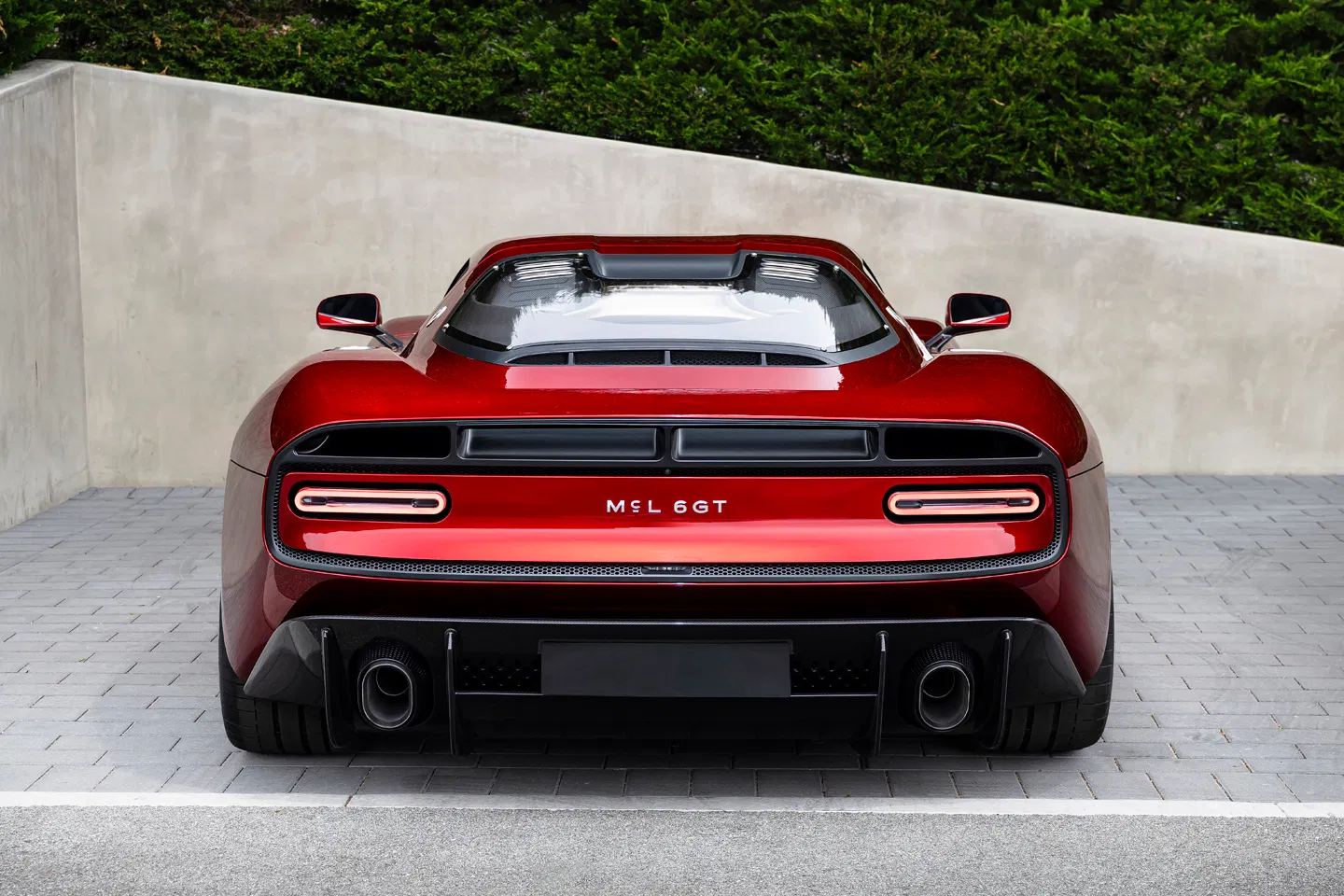
McLaren has spent decades chasing speed through lightweight engineering, aerodynamics and increasingly sophisticated technology. Now, the British supercar maker is turning its attention to something harder to measure: the feeling of driving.
The new McLaren McL 6GT concept previews an unusually analogue supercar built around a V8 engine, rear-wheel drive and a genuine manual transmission. Revealed during Monterey Car Week, the concept is expected to lead to a limited-production model in 2028.
Rather than presenting another machine obsessed solely with acceleration figures and lap records, McLaren is using the McL 6GT to explore a more mechanical relationship between car and driver.
McLaren McL 6GT Revives the Manual Gearbox
Perhaps the biggest surprise inside the McLaren McL 6GT is sitting between the driver and passenger: a manual gear lever.
The concept uses a six-speed manual transmission to send V8 power to the rear wheels. It marks McLaren’s first manual-equipped model since the legendary F1, which debuted in 1992.
That alone gives the new car a very different personality from McLaren’s current supercars.
Modern high-performance cars generally use rapid automatic or dual-clutch transmissions because they can shift faster than a human driver. McLaren appears willing to sacrifice some of that outright efficiency in exchange for involvement.
Every gear change becomes part of the experience rather than something handled automatically in the background.
An Analogue Supercar in an Increasingly Digital World
The manual transmission is only one part of McLaren’s approach.
The McLaren McL 6GT also uses hydraulic steering, physical switchgear and visible mechanical details intended to make the driver’s inputs feel deliberate and connected. McLaren has described the philosophy behind the car as focusing on a driving experience that is tactile, analogue and deeply mechanical.
That philosophy feels particularly significant at a time when cars are becoming increasingly software-driven.
Large touchscreens, electronic steering systems, automated gearboxes and driver-assistance technologies have made modern vehicles more capable and convenient. Yet some enthusiasts argue that these advances can also create distance between the driver and the machinery.
The McL 6GT takes the opposite approach.
It still uses modern engineering, but technology is being used to support the driving experience rather than dominate it.
McLaren McL 6GT Takes Inspiration From the M6GT
The McLaren McL 6GT is also deeply connected to the company’s history.
Its inspiration comes from the original McLaren M6GT, a road-car project conceived by company founder Bruce McLaren in the late 1960s. The M6GT itself developed from McLaren’s M6A Can-Am racing machine and represented Bruce McLaren’s ambition to create a lightweight, mid-engined road car.
That original vision never developed into full-scale production.
More than five decades later, McLaren has returned to the idea with a modern interpretation rather than simply recreating the historic car.
The result mixes unmistakable 1960s inspiration with contemporary supercar construction.
Retro Design Meets Modern Carbon Fibre
The McL 6GT immediately looks different from many current McLarens.
Its body has cleaner and more flowing surfaces, with a low silhouette influenced by the original M6GT and M6A racing car. A distinctive Kamm-style rear treatment further strengthens the historical connection.
However, underneath its retro-inspired shape is thoroughly modern engineering.
McLaren has built the concept around a lightweight carbon-fibre monocoque, while the bodywork is also made from carbon fibre.
That combination allows the company to preserve one of its most important design philosophies: reducing unnecessary weight.
Instead of covering the car with aggressive aerodynamic elements, the McL 6GT has a relatively clean appearance that allows its proportions to do much of the visual work.
It feels more like a reinterpretation of a classic racing prototype than another futuristic hypercar.
Small Details Celebrate Bruce McLaren
McLaren has also hidden several pieces of its history throughout the car.
Bruce McLaren’s signature appears in the engine bay, while the company’s historic Speedy Kiwi emblem can be found on elements including the fuel filler cap. The original M6GT also influences several smaller graphics incorporated into the modern concept.
These touches give the McL 6GT more than just a retro shape.
They connect the new machine directly with the ideas that helped establish McLaren as both a racing organisation and, eventually, a road-car manufacturer.
The Interior Keeps the Driver at the Centre
Inside, McLaren has resisted the temptation to turn the cabin into one enormous digital interface.
Digital instrumentation remains, but it is combined with physical controls, machined switchgear and the exposed manual shifter.
That gear lever is particularly important because it visually communicates the entire purpose of the car.
The driver is expected to participate.
Rather than simply selecting drive and allowing computers to manage the powertrain, the McL 6GT encourages the person behind the wheel to control engine speed, gear selection and steering inputs.
For enthusiasts who value interaction over outright numbers, that could become one of the car’s strongest attractions.
McLaren McL 6GT Is More Than a One-Off Concept
Importantly, the McL 6GT is not being shown purely as an experimental design exercise.
McLaren says the concept previews a production model expected in 2028. The road-going version is planned as an exclusive limited-production vehicle sitting outside the company’s regular supercar portfolio.
That positioning could allow McLaren to experiment with cars built around character and emotional appeal rather than simply pursuing ever-higher performance figures.
Full technical specifications have not yet been released, meaning details such as final power output, acceleration, top speed and production numbers remain to be confirmed.
For now, the philosophy matters more than the numbers.
Why the McLaren McL 6GT Matters
The McLaren McL 6GT arrives at an interesting moment for the supercar industry.
Performance has reached extraordinary levels. Computers can manage traction, transmissions and power delivery with incredible precision, while electrification is changing how manufacturers generate speed.
Against that backdrop, McLaren is asking a simpler question: what makes driving memorable?
Its answer appears to be interaction.
A manual gearbox requires effort. Hydraulic steering communicates through the driver’s hands. Physical switches provide immediate feedback. Rear-wheel drive and a powerful V8 add another layer of mechanical character.
None of those features represents a technological breakthrough.
That is exactly the point.
The McL 6GT suggests that the future of high-performance cars does not necessarily have to mean removing the driver from the process.
A Different Kind of Future for McLaren
The McLaren McL 6GT combines one of the company’s oldest road-car ambitions with some of its most advanced modern engineering.
Carbon-fibre construction and contemporary performance technology remain, but they are wrapped around an intentionally analogue experience.
If the production model arriving in 2028 stays close to the concept, McLaren could deliver something increasingly unusual: a modern supercar where changing gear, turning the steering wheel and working the throttle matter just as much as the numbers on the specification sheet.
For a company built around lightweight cars and driver involvement, the McL 6GT feels less like a trip into the past and more like a reminder that progress does not always require abandoning what made driving exciting in the first place.