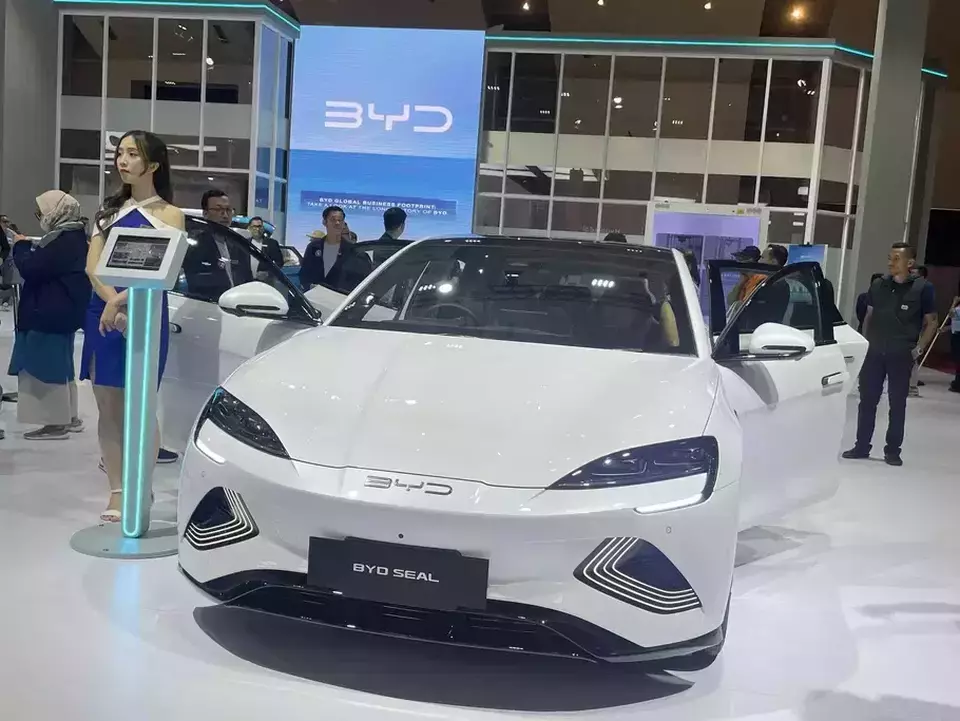
The Indonesia EV market is gaining momentum as electric carmakers, local manufacturers and commercial vehicle companies take center stage at the 2026 GAIKINDO Indonesia International Auto Show.
The 33rd edition of the exhibition opened at the Indonesia Convention Exhibition in BSD City, near Jakarta. The event, which runs through August 9, brings together more than 65 automotive brands.
Electric vehicles are among the main attractions this year. Manufacturers from China, South Korea, Vietnam and Indonesia are using the show to introduce new models, expand local production and target one of Southeast Asia’s most important car markets.
The exhibition also highlights a wider shift in Indonesia’s automotive industry. Battery-electric cars are becoming more visible, while hybrid models remain an important option for drivers concerned about charging access and long-distance travel.
Indonesia EV market attracts global manufacturers
Indonesia has traditionally been dominated by gasoline-powered vehicles, particularly multi-purpose vehicles and compact family cars.
That market is now changing.
Dedicated electric vehicle manufacturers are introducing models designed around the needs of Indonesian buyers. These include affordable city cars, family MPVs, premium crossovers, commercial vans and fleet vehicles.
Automakers are also increasing local assembly to reduce reliance on fully imported vehicles. Partnerships with Indonesian factories and battery suppliers are helping some brands meet local-content requirements.
This strategy could make electric vehicles more competitive while creating manufacturing and supply-chain opportunities inside the country.
Honda Super-One makes ASEAN debut
Honda attracted attention with the regional debut of the Super-One, a compact electric performance hatchback.
The lightweight model includes a Boost Mode button on the steering wheel. When activated, the system temporarily raises power output to 95 horsepower.
Honda has also added a simulated seven-speed paddle-shift system and active sound technology. These features are designed to make the electric hatchback feel more engaging to drive.
The Super-One is expected to launch with an initial production run of 100 vehicles for Indonesia.
Honda displayed the model alongside the Prelude sports hybrid concept, showing how the Japanese manufacturer is combining battery-electric and hybrid technologies.
BYD expands its Indonesia EV market presence
BYD presented a broad range of battery-electric passenger vehicles at the show.
Its display included the Dolphin hatchback, Atto 3 crossover, Seal sedan and M6 electric MPV.
The M6 is particularly relevant to the Indonesia EV market because multi-seater vehicles remain popular with families across Southeast Asia.
BYD’s expanding lineup allows it to compete in several segments rather than relying on a single high-volume model.
The company’s presence also reflects the growing influence of Chinese manufacturers in Indonesia’s electric vehicle industry.
Chery Q targets affordable electric car buyers
Chery introduced the Chery Q, a compact electric hatchback aimed at buyers seeking an affordable but technology-rich EV.
The car will be offered in Pure and Rizz versions. Chery says it can travel up to 400 kilometers under the NEDC testing standard.
Its fast-charging system can reportedly replenish the battery from 30% to 80% in 16.5 minutes.
The Chery Q also includes 20 advanced driver-assistance features, six airbags and an automated parking system.
Additional equipment includes a 540-degree camera, a 6.6-kilowatt vehicle-to-load system and an IP68-rated battery.
Chery says high-strength steel accounts for 82% of the vehicle’s body structure.
The model shows how manufacturers are increasingly competing through safety, software and convenience features instead of focusing only on price.
Changan offers electric and range-extended options
Changan made its Indonesian debut with the Deepal S05.
The crossover will be available as a fully electric vehicle and a range-extended electric vehicle.
The range-extended version uses an internal combustion engine to generate electricity for the battery rather than directly driving the wheels.
This approach may appeal to drivers who want an electric driving experience but remain concerned about charging availability.
Offering both versions gives Changan access to different types of buyers as Indonesia’s charging network continues to develop.
Leapmotor and Zeekr enter the market
Leapmotor marked its formal Indonesian launch by introducing the B10 and C10 electric crossovers.
The Stellantis-backed Chinese manufacturer is expanding into international right-hand-drive markets as it looks beyond its domestic customer base.
Zeekr, the premium electric vehicle brand owned by Geely Group, also made its official exhibition appearance.
Its entry suggests that manufacturers see growing demand for luxury electric cars in major Indonesian cities.
The arrival of more premium brands could broaden the Indonesia EV market beyond entry-level and mass-market models.
VinFast targets families and commercial fleets
Vietnamese manufacturer VinFast displayed one of the show’s most extensive all-electric lineups.
Its consumer range included the VF 3, VF 6, VF 7 and VF MPV 7.
The company also introduced electric vehicles developed for taxi, shuttle and fleet operations. These models include the Nerio Green, Herio Green and Limo Green.
VinFast is linking its vehicle expansion to the development of the V-GREEN charging network.
Charging infrastructure will be particularly important for commercial operators whose vehicles travel long distances or operate for extended hours each day.
A reliable network could help electric taxis and shuttles reduce downtime while supporting fleet expansion across major transport corridors.
Wuling introduces the Aira EV
Wuling unveiled the Aira EV as the successor to its popular Air EV.
The new model keeps the compact dimensions suited to crowded urban areas but adopts a four-door layout.
The extra doors are intended to improve passenger access and make the car more practical for daily use.
Wuling is positioning the Aira EV as an entry-level model for first-time electric car buyers.
Its compact design could appeal to drivers seeking an affordable vehicle for city travel, commuting and short-distance family use.
XPENG highlights smart vehicle technology
XPENG used the show to promote its intelligent vehicle systems under the theme “Physical AI For All.”
The company displayed the X9 luxury electric MPV and the G6 Pro crossover.
The X9 includes rear-wheel steering and an 800-volt charging system designed to support faster charging.
XPENG also highlighted its autonomous driving software and localized production footprint in Java.
Instead of focusing on futuristic transport concepts, the company emphasized software technology that can be used in production-ready road vehicles.
Polytron strengthens the domestic Indonesia EV market
Indonesian electronics and mobility company Polytron introduced the G3+ Special Collaboration electric SUV.
The model features a two-tone exterior, carbon-fiber design elements and Polytron’s XBR subwoofer technology.
Polytron is already well known in Indonesia for consumer electronics and electric motorcycles. Its expansion into electric cars gives the domestic market a recognizable local brand.
The G3 and G3+ are based on the Skyworth EV6 platform, which is also sold in some markets as the Skywell ET5.
Polytron’s owner, Djarum Group, partnered with Chinese automaker Skyworth to adapt the vehicle for Southeast Asian customers.
Polytron handles localized infotainment software, interior changes, after-sales support and audio integration.
The vehicles are assembled from knock-down kits at the PT Handal Indonesia Motor facility in Purwakarta, West Java.
Battery packs are supplied by Gotion High-Tech Indonesia.
This production arrangement gives the G3 and G3+ a local-content level of approximately 40%, according to the source report.
Polytron promotes battery subscription model
Polytron is also using a Battery as a Service model to reduce the cost of electric vehicle ownership.
Under this approach, customers subscribe to the battery instead of paying for its full cost as part of the vehicle purchase.
Polytron is pairing the program with a guaranteed resale value of 70% after three years.
The model could lower the initial purchase barrier while reducing concerns about battery degradation and used-EV values.
However, its long-term appeal will depend on subscription costs, contract terms and the availability of battery support.
Electric motorcycles support the Indonesia EV market
Electric two-wheelers were also prominent at GIIAS 2026.
Indonesian companies ALVA and Polytron displayed new electric scooters and updates to their battery-swapping networks.
Other manufacturers, including Pacific eBike, Exotic, Kupprum and NUV, presented electric commuter models.
Motorcycles are widely used in Indonesia’s densely populated cities, making two-wheelers an important part of the transition to cleaner transport.
Affordable electric scooters could help reduce fuel use and localized emissions if charging and battery-swapping services become widely available.
Commercial electric vehicles gain attention
Commercial transport played a larger role at this year’s exhibition.
Manufacturers displayed electric delivery vans, buses, light trucks and heavy-duty vehicles designed for logistics and municipal services.
Farizon, Geely’s commercial vehicle division, showcased its Super Van platform alongside electric light trucks and urban panel vans.
The company says its dedicated by-wire platforms could reduce total ownership costs by more than 50% compared with diesel vehicles used for urban deliveries.
Actual savings will depend on purchase prices, electricity costs, vehicle use and maintenance requirements.
Smart Automated Group displayed electric buses designed for public transport and industrial shuttle operations.
Wuling also promoted its Formo commercial platform for inner-city delivery and business use.
Fleet operators may adopt electric vehicles more quickly than private buyers because their routes, charging schedules and operating costs are easier to plan.
Hybrids remain central to the transition
Although battery-electric brands attracted significant attention, established automakers continued to promote hybrids.
Hybrid vehicles may provide a more immediate option in areas where charging infrastructure remains limited.
Mitsubishi introduced the Xforce HEV, its first locally manufactured hybrid vehicle in Indonesia.
The model combines a 1.6-liter Atkinson-cycle gasoline engine with an electric motor. It can operate in electric-only, series-hybrid and parallel-hybrid modes.
Nissan displayed the X-Trail e-POWER with e-4ORCE all-wheel drive and the Serena e-POWER family MPV.
In Nissan’s e-POWER system, the gasoline engine generates electricity while the wheels are powered by electric motors.
Toyota launched the Land Cruiser HEV, combining a twin-turbocharged V6 engine with an electric motor.
It also displayed a battery-electric Hilux prototype to assess interest from commercial fleet customers.
Hyundai develops an electric MPV for Southeast Asia
Hyundai presented the Neira electric MPV prototype.
The three-row model has been designed specifically for Southeast Asian customers, where spacious family vehicles remain in high demand.
The Neira joins Hyundai’s wider electric lineup, which includes the IONIQ 5, IONIQ 6 and IONIQ 9.
A locally focused electric MPV could give Hyundai a stronger position in a segment that plays a major role in Indonesian vehicle sales.
Indonesia EV market enters a new phase
GIIAS 2026 shows that Indonesia’s transition to electric mobility is no longer being driven by only a few manufacturers.
Global brands, Chinese startups, Vietnamese companies and domestic producers are now competing across several vehicle categories.
Local assembly, battery partnerships and charging networks are becoming just as important as vehicle specifications.
The market is also developing through several technologies at once. Fully electric cars are expanding, while hybrids and range-extended models offer alternatives for drivers who are not ready to depend entirely on charging.
Commercial vehicles, taxis, delivery fleets and electric motorcycles may accelerate adoption because their operating patterns make fuel and maintenance savings easier to measure.
The Indonesia EV market still faces challenges, including vehicle prices, charging access and consumer confidence. However, the number and variety of models displayed at GIIAS 2026 indicate that the shift toward cleaner transport is gathering speed.