Huawei AI partnerships are set to expand further into the pharmaceutical industry as the Chinese technology giant looks for a bigger role in AI-powered drug discovery, medicine development and clinical healthcare.
William Zhang, president of Huawei’s healthcare business unit, said the company expects to deepen its work with pharmaceutical companies as artificial intelligence becomes more widely used throughout the drug-development process.
Huawei’s current pharmaceutical projects are mainly with Chinese drugmakers, but the strategy shows how the company is pushing beyond its traditional telecommunications and consumer technology businesses into specialized AI applications.
The pharmaceutical industry is becoming an increasingly important battleground for technology companies as drugmakers search for ways to shorten research timelines, screen potential compounds more efficiently and improve clinical development.
Huawei AI partnerships are moving deeper into pharmaceuticals
Speaking to Reuters, Zhang said Huawei expects more collaboration and results to emerge as its medical AI research develops.
The company wants to work with pharmaceutical firms across different stages of the industry, including drug manufacturing, clinical applications and eventual implementation. Huawei already has collaborations involving clinical practice in hospitals and is exploring additional opportunities, although Zhang did not identify prospective partners.
For Huawei, this is not an entirely new field.
The company has spent several years developing AI and cloud technologies aimed at healthcare and pharmaceutical research. What is changing now is the scale of its ambition and the growing importance of generative AI, accelerated computing and specialized scientific models within the pharmaceutical industry.
Why Huawei sees an opportunity in AI drug discovery
Developing a new medicine can take years of laboratory work, testing and clinical trials. It is also extremely expensive, with many potential treatments failing before reaching patients.
Artificial intelligence cannot eliminate those challenges, but researchers hope it can improve some of the earliest stages of the process.
Machine-learning systems can analyze enormous datasets, identify promising biological targets, predict molecular properties and help researchers narrow down potential drug candidates before more expensive laboratory testing begins.
Industry forecasts cited by Reuters suggest machine learning could potentially halve some early-stage drug-development timelines and costs within the next three to five years. That remains a forecast rather than a guaranteed outcome, but it helps explain why pharmaceutical and technology companies are spending heavily on the field.
Huawei wants its computing infrastructure and AI tools to become part of that shift.
Huawei’s Ascend and Kunpeng chips play a central role
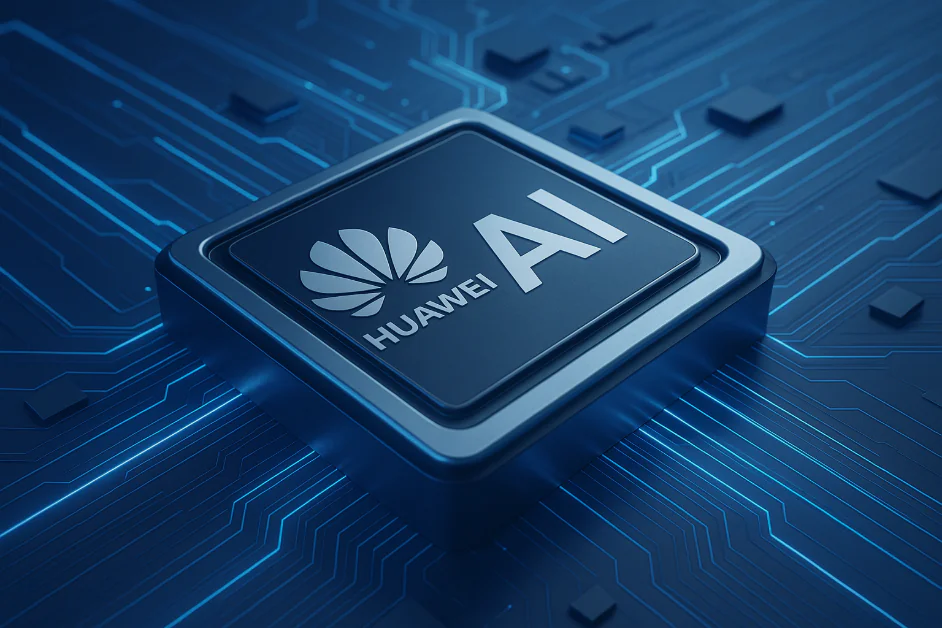
One important element of Huawei AI partnerships in pharmaceuticals is the company’s own computing hardware.
Huawei offers Ascend AI processors and Kunpeng server CPUs alongside tools that can help researchers screen potentially useful drug compounds.
This gives Huawei an opportunity to provide both the computing infrastructure and software environment required for demanding pharmaceutical AI workloads.
In May 2026, Huawei highlighted a project involving state-owned Guangzhou Pharmaceutical Holdings. According to the company, the collaboration achieved production validation of independently developed AI drug-research models adapted to Huawei’s Ascend and Kunpeng technologies.
The project is particularly important for Huawei because it demonstrates that pharmaceutical AI workloads can be adapted to its domestic computing ecosystem.
That could become increasingly valuable to Chinese companies looking to build sophisticated AI systems around locally available processors and infrastructure.
Huawei has been working on AI drug models for years
Huawei’s pharmaceutical AI ambitions go back well before the current wave of generative AI investment.
In 2021, Huawei Cloud introduced its Pangu Drug Molecule Model, developed with the Shanghai Institute of Materia Medica under the Chinese Academy of Sciences.
Huawei says the model learned chemical structures from approximately 1.7 billion small molecules and was designed to assist researchers with different stages of drug design.
The system uses AI to help predict which compounds may interact with particular biological targets. Researchers can then use those predictions to narrow the enormous number of possible molecules requiring further investigation.
Huawei has previously said its technology helped researchers significantly reduce the time required to identify promising compounds in one antimicrobial research project. Those results relate to specific research circumstances and should not be interpreted as evidence that similar reductions can automatically be achieved across all drug-development programs.
That distinction is important because discovering a promising molecule is only the beginning of the much longer process required to establish whether a medicine is safe and effective.
Huawei AI partnerships reflect a wider technology race
Huawei is far from the only major technology company pursuing pharmaceutical AI.
Nvidia has become particularly aggressive in the field, combining its powerful AI chips with software platforms designed for biology and drug development.
In January 2026, Nvidia and pharmaceutical giant Eli Lilly announced a co-innovation AI laboratory focused on drug discovery. The companies said they planned to jointly invest up to $1 billion over five years in infrastructure and research.
Nvidia has also worked with other major pharmaceutical companies, reflecting the growing convergence between biotechnology and advanced computing.
This competition is creating a new market where technology companies are not necessarily developing medicines themselves. Instead, many want to supply the chips, cloud infrastructure, AI models and development platforms that pharmaceutical researchers use.
Huawei appears to be pursuing a similar opportunity, particularly within China.
Healthcare is becoming a bigger part of Huawei’s AI strategy
Huawei’s pharmaceutical ambitions also fit into a broader effort to expand its presence in healthcare technology.
In June 2026, the company launched an updated Alliance on Healthcare & Education AI Digitalization program, known as AHEAD, aimed at strengthening cooperation between Huawei and industry partners.
Huawei said the initiative would support greater use of AI and digital infrastructure in healthcare and education. More than 500 customers and partners from over 40 countries and regions attended the related convention in China.
Healthcare offers Huawei several potential areas for expansion, including hospital infrastructure, medical data platforms, AI-assisted diagnosis, cloud services and scientific computing.
Pharmaceutical research could become another important part of that portfolio.
China could be Huawei’s most important pharma AI market
For now, Zhang says Huawei’s pharmaceutical projects remain primarily focused on domestic drugmakers.
China provides a large potential market.
The country has a significant pharmaceutical manufacturing industry, a rapidly expanding biotechnology sector and strong government interest in developing domestic AI and semiconductor capabilities.
Huawei is also one of China’s most important suppliers of computing infrastructure, giving it an existing base from which to approach pharmaceutical and healthcare organizations.
Its ability to combine cloud platforms, networking equipment, storage systems, processors and AI models could help it compete for increasingly complex healthcare technology projects.
At the same time, the company will face competition from both established cloud providers and specialized AI drug-discovery companies.
AI could change how pharmaceutical research is conducted
The attraction of AI in pharmaceuticals is easy to understand.
Traditional drug discovery requires researchers to evaluate huge numbers of possible compounds. AI systems can process far more information than researchers could realistically examine manually, potentially helping scientists decide which candidates deserve further laboratory investigation.
AI can also be used for tasks such as protein analysis, molecular generation, toxicity prediction, clinical-trial planning and scientific literature analysis.
However, AI predictions still require extensive scientific validation.
A model identifying a promising molecule does not prove that the compound will become a successful medicine. Laboratory studies, safety testing and carefully regulated clinical trials remain essential.
The long-term winners in pharmaceutical AI may therefore be companies that can combine powerful computing technology with high-quality scientific data and deep pharmaceutical expertise.
Huawei’s pharma push is only beginning
Huawei’s plans for more pharmaceutical partnerships suggest healthcare is becoming another important test of the company’s broader AI strategy.
Its Ascend and Kunpeng processors provide the computing foundation, while technologies such as the Pangu Drug Molecule Model give Huawei experience in applying AI directly to scientific research.
The next challenge will be turning that technology into larger commercial partnerships and measurable pharmaceutical breakthroughs.
For now, Huawei has not announced how many new drugmakers it expects to work with or provided a timetable for the expansion.
Still, the direction is clear.
As pharmaceutical companies increase their investment in artificial intelligence, Huawei AI partnerships could become an increasingly important part of China’s effort to combine domestic computing infrastructure with advanced drug research.
And with Nvidia and other technology giants investing heavily in the same market, the race to become a key technology provider for the pharmaceutical industry is only getting more competitive.