Long before Steve Jobs helped turn Apple into one of the biggest technology companies in the world, he was a teenager experimenting with electronics and trying to make sense of how they worked.
One of those early experiments has now become a valuable piece of Steve Jobs memorabilia.
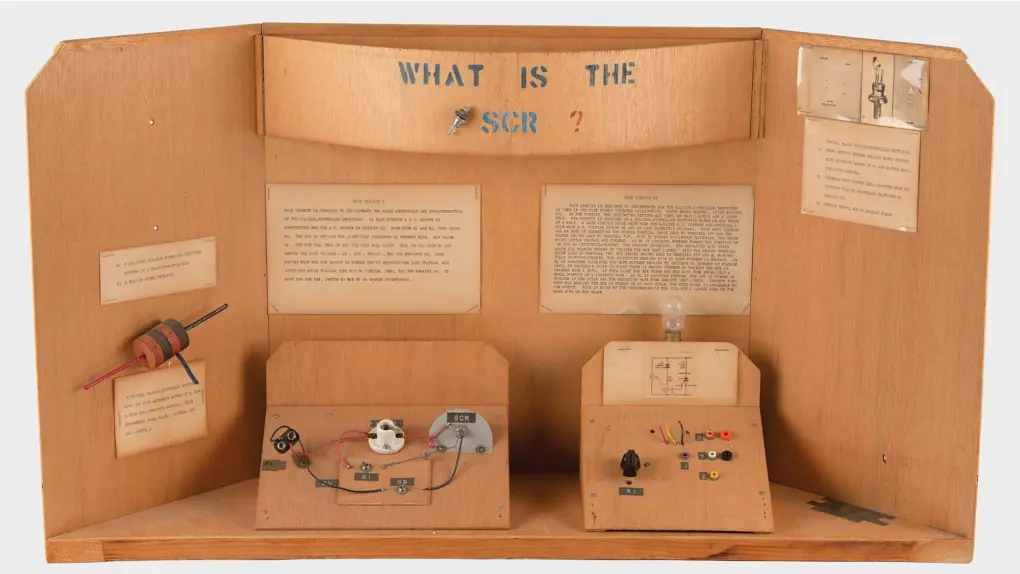
A science fair project Jobs built while in eighth grade has sold for $34,375 at auction, more than the $20,000-plus estimate placed on it before the sale.
The project was offered by RR Auction as part of its Apple 50th Anniversary Auction, which closed on August 20, 2026. RR Auction confirmed the final $34,375 price included the buyer’s premium.
For collectors, its appeal goes beyond the circuitry and plywood. The project offers a rare glimpse of Jobs years before Apple existed and before his name became inseparable from products such as the Macintosh, iPod and iPhone.
Steve Jobs Memorabilia From His School Days
The project dates back to Jobs’ time at Cupertino Junior High School in California.
Titled “What is the SCR?”, it focuses on the silicon-controlled rectifier, an electronic component that can be used to control electrical power.
It wasn’t simply a written report.
Jobs built a plywood display measuring roughly 32.5 inches by 18 inches by 7.5 inches and divided it into three sections explaining the technology. The project was accompanied by a 10-page report on the same subject.
One part of the display shows the different semiconductor layers inside a silicon-controlled rectifier. Another includes demonstration circuits showing its basic operation and practical uses, including motor-speed control and light dimming.
The final section contains a diagram and explanation of a 25-amp silicon-controlled rectifier.
For a school assignment completed by an eighth grader, it was a fairly ambitious piece of work.
Why This Steve Jobs Memorabilia Is Different
Collectors can already find old Apple computers, advertisements, documents and other historical items connected to the company.
This piece of Steve Jobs memorabilia is different because it predates Apple entirely.
The report is dated February 29, 1968. Apple would not be founded until 1976, meaning Jobs completed the project around eight years before the company began.
That makes it less about Apple as a business and more about the person Jobs was before the world knew his name.
There are also small details that make the project feel surprisingly personal.
Jobs left instructions explaining how judges could use equipment to test part of his demonstration. He even reminded them to unplug it afterward. MacRumors, which reported on the auction, noted that the accompanying report also identifies Jobs and his science teacher.
It’s the kind of detail that reminds you this wasn’t created as a collectible.
It was homework.
The Project Survived for Decades
Another reason historical artifacts become valuable is provenance — the documented story of where an item came from and who owned it.
According to information associated with the auction, the science project survived through the Jobs family circle before eventually reaching collectors.
That history matters because the market for rare technology artifacts increasingly values items that can be reliably connected to the people and events that shaped the industry’s early years.
For anyone following the history of [Apple – add internal link], the project offers something that even an early Apple computer cannot: a physical connection to Jobs’ teenage years.
Steve Jobs Memorabilia Is Attracting Serious Money
The $34,375 science project wasn’t the only valuable Apple artifact in the auction.
RR Auction’s Apple 50th Anniversary sale included an extensive collection of early computers, signed documents, prototypes and personal items linked to Apple and its founders.
A Steve Jobs-signed Apple Computer Company check from 1976, connected to the production of early Apple-1 boards, sold for $53,594.
A Macintosh 512K computer that Jobs gave to his father sold for $32,333, while an Apple II computer also given to his father brought in $12,079.
These aren’t ordinary second-hand electronics.
Collectors are paying for the history attached to them.
That is also why Steve Jobs memorabilia can sell for dramatically more than the ordinary market value of the physical object itself.
Why Collectors Pay So Much
Scarcity is a major part of the attraction.
There is only one science project that Steve Jobs personally made for this particular eighth-grade assignment. Unlike an iPhone or Macintosh, it was never manufactured for thousands or millions of customers.
Its personal connection to Jobs makes it even harder to replace.
Then there is Apple’s place in technology history.
From the and Macintosh to the iPod, iPhone and Apple Watch, the company has repeatedly influenced how people use consumer technology.
Collectors interested in that history naturally want objects connected to its beginnings.
And objects from Jobs’ life before Apple can be particularly fascinating because there are relatively few of them.
Steve Jobs Memorabilia Shows the Person Before Apple
It would be easy to look at the eighth-grade project today and treat it as evidence that Jobs was destined to become a technology icon.
That would probably be reading too much into a school assignment.
At the time, he was simply a teenager interested in electronics.
There was no Apple Store, no Macintosh, no iPhone and no trillion-dollar technology company.
That ordinary beginning is what makes the project interesting.
Rather than showing Jobs as the polished product presenter people would later see on stage, this piece of Steve Jobs memorabilia captures him as a student trying to understand a piece of technology well enough to explain it at a science fair.
Apple History Has Become a Collectors’ Market
As early personal computing moves further into history, physical artifacts from that era are increasingly being treated as serious collectibles.
The market now includes original computers, prototypes, signed business documents, advertisements, photographs and personal belongings.
Items with strong provenance and a direct connection to Jobs often receive particular attention.
You can see the same trend with early where relatively ordinary-looking documents can become extremely valuable because of the role they played in the company’s beginnings.
The $34,375 science project fits neatly into that market.
It isn’t valuable because a plywood electronics display would normally cost tens of thousands of dollars.
It’s valuable because Steve Jobs made it.
A $34,375 Piece of Homework
Perhaps the most remarkable part of the story is how ordinary the project once was.
In 1968, it was simply something a student had prepared for school.
Nearly six decades later, the same collection of plywood, circuits, diagrams and typed pages has become valuable Steve Jobs memorabilia and a small piece of computing history.
The buyer paid $34,375 for it.
But what makes the project memorable isn’t really the price.
It’s the snapshot it provides of Steve Jobs before Apple, before the fame and before anyone knew just how much the technology industry around him was about to change.