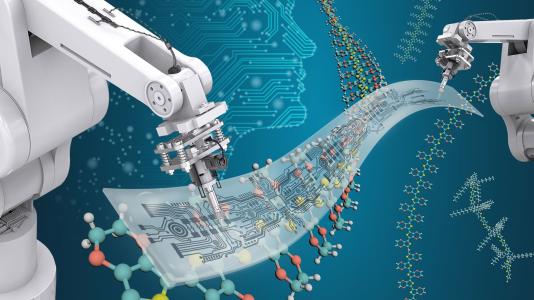
Artificial intelligence can predict thousands or even millions of potentially useful materials on a computer. But there is a much harder question: can those materials actually be made, tested and used in the real world?
That challenge is driving a new phase of AI materials discovery in which machine-learning systems are being connected directly with laboratory experiments. Instead of asking AI to simply predict promising materials, scientists are increasingly allowing algorithms to learn from physical experiments, choose what should be tested next and refine their predictions as new evidence arrives.
The approach could shorten the lengthy trial-and-error process traditionally involved in developing catalysts, electronic materials, chemicals and other advanced materials.
Researchers are already demonstrating closed-loop systems in which artificial intelligence analyses previous results, predicts promising experiments and then uses automated equipment to perform the next round of tests. A July 2026 perspective in Communications Materials described these systems as autonomous experimentation platforms that can learn more quickly while using fewer experimental resources.
The goal is not simply to make laboratories more automated. It is to make experimentation itself more intelligent.
Why AI Materials Discovery Needs Real Experiments
Materials science presents an enormous search problem.
Changing the chemical composition of a material, how it is processed, its temperature, pressure or microscopic structure can dramatically alter its final properties.
Researchers searching for a better battery material, catalyst or semiconductor may therefore face a huge number of possible combinations.
Artificial intelligence is useful because it can identify patterns across these complicated parameter spaces and suggest which combinations appear most promising.
But predictions alone have limits.
A computer model may predict that a particular material should have excellent properties, yet synthesising it in a laboratory could prove difficult. A material that performs well under ideal laboratory conditions may also degrade quickly, cost too much to manufacture or behave differently when produced at industrial scale.
Research into machine-learning-guided catalyst development has highlighted exactly this gap. Scientists note that many AI studies still rely heavily on computational data while overlooking experimental information such as synthesis conditions, reaction environments, selectivity and material degradation.
Connecting artificial intelligence with real experiments can help close that gap.
Instead of treating computational prediction and physical experimentation as separate stages, researchers can create a feedback loop between them.
How AI and Experiments Work Together
The basic idea behind modern AI materials discovery is surprisingly straightforward.
Scientists first define what they want from a material. That might be higher conductivity, better catalytic activity, improved durability or a particular combination of properties.
An AI model then examines the available data and selects an experiment likely to provide useful information.
Automated laboratory equipment performs the experiment.
The results are measured and returned to the AI model.
The model updates what it knows and selects another experiment.
The cycle continues until researchers identify promising materials or understand the system well enough to meet their objective.
In autonomous experimentation systems described by researchers at the US National Institute of Standards and Technology and collaborating institutions, AI can analyse existing information, predict the outcomes of possible experiments and choose the next experiments expected to advance the research most efficiently.
This is fundamentally different from simply automating a long predetermined list of experiments.
The system can change direction as it learns.
AI Materials Discovery Can Reduce Trial and Error
One of the biggest attractions of the approach is its ability to reduce unnecessary experiments.
Traditional research may involve systematically testing combinations across a predefined grid. That method is reliable, but it can require scientists to perform many experiments that ultimately contribute little new information.
Machine learning can instead concentrate attention on the areas that appear most informative.
Research published in npj Computational Materials in May 2026 showed that active-learning approaches used for mapping phase diagrams could reduce the required number of measurements by roughly 80% compared with conventional grid sampling.
The researchers went further by developing a system called PhaseTransfer.
Rather than forcing the AI to begin learning from scratch every time scientists investigate a new material system, PhaseTransfer uses knowledge obtained from previously studied systems.
The researchers demonstrated the approach on an autonomous microfluidic platform and reported that it reduced sampling requirements by about another 50% compared with conventional active learning in their tests.
That illustrates an important direction for AI materials discovery: machines may increasingly be able to carry lessons from one research project into another.
Experiments Could Teach AI Instead of Simply Testing It
Traditionally, experiments often come near the end of a computational discovery process.
A computer identifies a promising candidate, and scientists then test whether the prediction was correct.
Closed-loop experimentation changes that relationship.
Each experiment becomes new training information.
An unsuccessful experiment is not necessarily wasted effort because it tells the model which direction may be less promising. A surprising result may be even more valuable because it can reveal weaknesses in the model’s assumptions.
Researchers studying autonomous laboratories argue that this ability to select information-rich experiments can allow scientists to learn faster while using fewer resources.
In other words, the laboratory is no longer just validating artificial intelligence.
It is continuously teaching it.
AI Is Already Controlling Real Laboratory Equipment
The concept has moved beyond simulations.
Researchers have demonstrated AI agents controlling sophisticated scientific instruments during physical experiments.
One example is AILA, an Artificially Intelligent Laboratory Assistant developed to work with atomic force microscopy.
Atomic force microscopes allow scientists to examine surfaces at extremely small scales, but operating them can require considerable expertise.
Researchers tested AILA on five real-world experimental tasks, including identifying an indentation in glass, detecting graphene flakes, determining graphene layer numbers, calibrating the microscope and measuring friction on graphite.
The system used an AI planner to coordinate specialised agents responsible for instrument control and data analysis.
During experiments, software-generated commands were translated into physical actions through an interface connected directly to the microscope.
That represents an important development.
AI is moving from analysing experimental results after scientists have collected them to participating directly in how the experiments themselves are carried out.
Autonomous Labs Could Work Around the Clock
Another potential advantage is speed.
Traditional laboratory research depends heavily on how many experiments scientists can physically prepare, run and analyse.
Robotic systems can operate for extended periods and repeat precisely controlled experimental procedures.
When those robots are combined with AI decision-making, laboratories can potentially run repeated cycles of experimentation without researchers manually selecting every condition.
A Communications Materials paper published in July 2026 said autonomous experimentation systems have already demonstrated the ability to pursue focused research goals with substantially fewer experiments than traditional approaches.
The next step envisioned by researchers is larger autonomous laboratories where different AI agents coordinate multiple scientific instruments and research activities rather than controlling only one narrow experimental system.
Such laboratories would operate less like a robot performing repetitive tasks and more like an interconnected research system.
AI Materials Discovery Is Reaching Complex Chemistry
Catalysis provides a particularly useful test.
Catalysts accelerate chemical reactions and are essential to many industrial processes. Finding an effective catalyst can involve changing numerous variables simultaneously, including chemical composition, ligands, temperature, pressure and reaction conditions.
That produces an enormous experimental search space.
A 2026 Nature Communications study introduced an autonomous laboratory known as Flex-Cat that combines robotic experiments with an AI decision-making system for homogeneous catalysis.
The platform can automatically handle reagents and conduct reactions under controlled inert environments as well as elevated temperature and pressure.
Its AI analyses experimental results, updates a predictive model and proposes the next reaction conditions that the robotic system should investigate.
During three optimisation campaigns, the system generated more than 360 experimental data points while automatically performing experiments, analysing outcomes and updating its models.
Importantly, the researchers designed the AI to work within real physical constraints rather than searching an imaginary mathematical space where every possible experiment could be performed.
Real-World Constraints Matter
That distinction may determine whether AI-driven discoveries eventually become useful industrial technologies.
A theoretically excellent material is not necessarily a practical one.
Real products have constraints.
A catalyst must survive operating conditions for long periods. A battery material must be manufacturable and safe. A semiconductor must be produced consistently. Industrial processes must remain economically viable.
Researchers examining machine learning for single-atom catalysts have warned that outstanding laboratory performance cannot simply be assumed to translate into industrial performance. Cost, scalability, long-term durability and operational efficiency must also be considered.
That is why combining AI with experimental evidence is becoming so important.
The algorithm needs information about how materials actually behave outside idealised simulations.
Bigger and Better Experimental Datasets Could Improve AI
AI systems are only as useful as the information they learn from.
Materials science presents a particular problem because high-quality experimental datasets can be relatively small compared with the massive datasets used to train general-purpose AI systems.
Experiments are expensive. Different laboratories may also use different equipment, procedures and reporting standards.
Researchers working on machine-learning-guided catalysts have called for more robust experimental databases, standardised testing methods and improved data quality so that AI systems can learn from comparable results.
Larger and more consistent datasets could eventually make models more general.
Instead of developing an AI system that understands one narrow family of materials, researchers could build models capable of transferring knowledge across related scientific problems.
PhaseTransfer offers an early example of that principle by allowing information from previously characterised phase diagrams to help guide experiments on new systems.
Physics Can Make AI Materials Discovery Smarter
Another emerging strategy is to teach AI not only from data but also from established scientific knowledge.
Researchers refer to this as physics-informed or physics-integrated AI.
Instead of allowing an algorithm to explore every mathematical possibility, known physical principles can help constrain its predictions to scientifically meaningful regions.
Researchers studying autonomous materials laboratories argue that physics-informed AI can prevent low-value experiments and help systems focus on questions that distinguish between plausible physical mechanisms.
This can be especially valuable in materials science, where researchers often have limited experimental data but decades of accumulated knowledge about physical and chemical behaviour.
The combination could make AI more useful than either purely data-driven learning or traditional scientific modelling alone.
Scientists Still Have a Crucial Role
Despite the term “self-driving laboratory,” these systems do not make scientists obsolete.
Researchers still need to decide which problems matter, determine what constitutes a useful material, establish safety limits and interpret why particular discoveries are scientifically meaningful.
Human judgement becomes particularly important when AI models behave unpredictably.
Researchers studying future autonomous laboratories have warned that large language models can produce confident but incorrect outputs and may lack sufficient interpretability for direct control of expensive scientific equipment.
They suggest that different types of AI may therefore be given different responsibilities.
A language model might help researchers interact with laboratory systems, while more specialised and interpretable algorithms handle safety-sensitive experimental decisions.
The likely future is therefore not laboratories without scientists.
It is laboratories where scientists spend less time manually conducting repetitive experiments and more time deciding what questions should be asked.
AI Mistakes Become More Serious in Physical Laboratories
An incorrect chatbot response is inconvenient.
An incorrect instruction sent to laboratory equipment can have much greater consequences.
Scientific instruments may be expensive and delicate, while experiments can operate under demanding conditions involving heat, pressure or reactive chemicals.
That means autonomous experimentation requires safeguards that ordinary software does not.
The Flex-Cat research, for example, incorporated hardware design, software integration and real-time safety monitoring for experiments conducted under elevated pressure and temperature.
Researchers studying autonomous laboratories are also exploring digital and physical “sandboxes” in which AI strategies can be evaluated before they are trusted with broader control of laboratory equipment.
Safety, reproducibility and explainability could therefore become as important as speed.
From One Self-Driving Experiment to an Entire AI Laboratory
Most autonomous experimentation systems today remain highly specialised.
One might optimise a catalyst. Another might control a microscope. Another might map a phase diagram.
Researchers now envision connecting many of these systems.
A future autonomous materials laboratory could contain different instruments controlled by specialised AI agents, with another AI system coordinating the overall research campaign.
One agent might decide which material should be synthesised. Another could control synthesis equipment. Another could operate microscopes or spectroscopy instruments. A separate system could analyse results.
Researchers have proposed multi-agent architectures in which these systems communicate and share resources while a coordinating AI manages the broader research objective.
That would move materials research closer to a genuine self-driving laboratory rather than an automated individual experiment.
Why Faster Materials Discovery Matters
Many major technological challenges are ultimately materials problems.
Improving energy technologies requires materials that can store, convert or transport energy more effectively.
Industrial processes need catalysts that deliver better performance while reducing energy and resource use.
Electronics require materials with precisely controlled electrical and structural properties.
Machine-learning research in catalyst development is already targeting applications connected with energy conversion and industrial chemistry, while autonomous experimentation platforms are being tested across catalytic, electronic and nanoscale materials research.
Finding useful materials faster could therefore influence technologies far beyond the laboratory where the discovery occurs.
But speed alone is not enough.
The ultimate objective is finding materials that can survive the transition from computer prediction to laboratory experiment and eventually to practical use.
AI Materials Discovery Is Moving Beyond Prediction
The biggest change taking place in materials science may not be the increasing power of AI models themselves.
It is the shrinking distance between prediction and experimentation.
For years, much of the excitement around artificial intelligence in materials science centred on screening huge numbers of theoretical candidates.
Now scientists are increasingly asking AI to interact with the physical world.
The algorithm proposes an experiment. A machine carries it out. The result returns to the model. The AI learns and decides what should happen next.
Research published in 2026 shows this approach being applied to phase mapping, complex catalysis and sophisticated microscopy, while scientists are already designing systems capable of coordinating entire laboratories.
There are still significant challenges.
Experimental data must become more consistent. AI systems need stronger safeguards and better uncertainty estimates. Discoveries must be tested for manufacturability, durability and cost before laboratory success can become commercial success.
Yet the direction is becoming clearer.
AI materials discovery is evolving from asking computers to predict what might work to building research systems that can test those ideas, learn from failure and adapt their next move.
That combination of artificial intelligence and physical experimentation could ultimately prove far more powerful than either approach on its own — because solving real-world materials problems requires more than a convincing prediction.
It requires evidence that the material actually works.