Ceva AI licensing has taken a major step forward after the company announced a new agreement with a major U.S. software and AI platform company for a custom AI silicon programme.
The deal will see Ceva’s NeuPro-M neural processing unit technology used as part of a next-generation intelligent computing platform. The customer was not named, but Ceva described the agreement as one of the most strategically important AI licensing deals in its history.
The announcement highlights a major shift in the technology industry. Software and AI platform companies are no longer relying only on off-the-shelf chips. More of them are moving toward custom silicon to improve performance, reduce power use and gain better control over the full user experience.
For Ceva, the deal expands its reach beyond traditional semiconductor companies and device manufacturers. It also places the company more directly inside the fast-growing market for AI-first computing devices.
Ceva AI licensing deal expands beyond traditional chip customers
The Ceva AI licensing deal is important because it shows how the company’s customer base is changing.
Ceva has long supplied silicon and software intellectual property for connected devices, smart edge products, wireless systems and AI-enabled hardware. Its technologies are already used across consumer electronics, automotive, industrial IoT and mobile markets.
But this new agreement points to a broader opportunity.
Major software and AI companies are increasingly designing their own chips. These companies want to control more of the computing stack, from the operating system and software frameworks down to the silicon itself.
That level of control can deliver major benefits. Custom chips can be designed around specific workloads, device types and user experiences. They can also be tuned for better power efficiency, which is especially important in portable devices.
Ceva’s NeuPro-M technology gives the unnamed customer a ready foundation for building AI acceleration into custom silicon.
Why custom AI silicon matters
The Ceva AI licensing agreement comes at a time when artificial intelligence is reshaping the design of computing devices.
For decades, CPUs handled general computing. GPUs later became essential for graphics and large-scale parallel processing. Now, neural processing units, or NPUs, are becoming a third major layer of modern computing.
NPUs are designed to run AI tasks more efficiently. They can support workloads such as image recognition, voice processing, generative AI, multimodal AI and on-device inference.
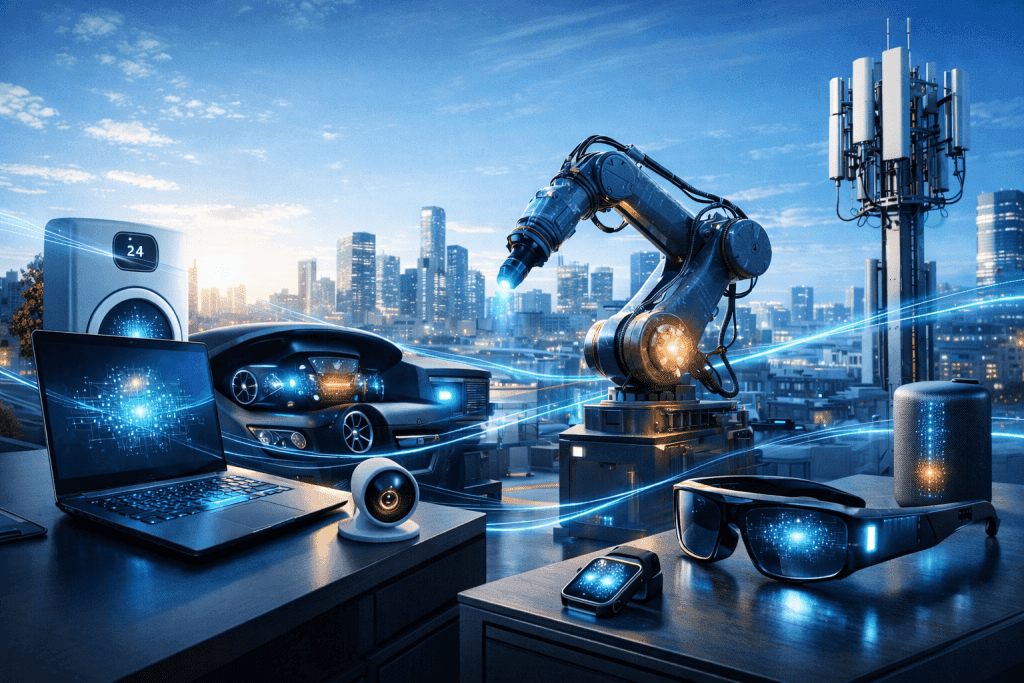
This matters because more AI activity is moving from the cloud to edge devices. Phones, laptops, wearables, smart home products and connected machines are expected to process more intelligence locally.
Local AI can improve speed, privacy and responsiveness. It can also reduce the need to send every request to cloud servers.
But running advanced AI on a device is difficult. The chip must deliver strong performance while staying within strict battery, heat and size limits. That is where custom AI silicon becomes valuable.
NeuPro-M chosen for on-device AI acceleration
Ceva said its NeuPro-M architecture was selected to provide scalable and power-efficient AI acceleration for advanced on-device inference workloads.
The technology is designed to support generative AI, multimodal AI, emerging agentic AI tasks and other machine learning applications. It is also built for devices that must operate within tight power, area and thermal limits.
That combination is important for intelligent edge computing.
A powerful AI chip is not useful in a portable device if it drains the battery too quickly or generates too much heat. For next-generation devices, efficiency is just as important as raw performance.
NeuPro-M gives customers the ability to integrate AI acceleration directly into their own silicon designs. This allows hardware and software teams to optimize performance, power and user experience together.
Ceva also said it worked closely with the customer to apply neural network optimizations tailored to the customer’s target AI workloads.
Ceva AI licensing supports full-stack optimization
One of the most important parts of the Ceva AI licensing deal is the focus on full-stack optimization.
Technology companies that control both software and hardware have a major advantage. They can design chips that work closely with the operating system, applications and AI frameworks.
This can create a better experience than using standard processors that were not built for a company’s specific platform.
For example, an AI feature inside a future device may need to respond instantly, use very little power and work reliably without relying on the cloud. A custom AI chip can be designed with those exact needs in mind.
This is why more platform companies are investing in silicon design. They want tighter control over performance, battery life, heat management and product differentiation.
Ceva’s role is to provide the AI IP foundation that helps these companies build custom processors faster and with less risk.
What the deal means for Ceva
The Ceva AI licensing deal strengthens the company’s position in the smart edge and AI silicon markets.
Ceva describes itself as a licensor of silicon and software IP for devices that connect, sense and infer. Its portfolio includes wireless connectivity, edge AI NPUs, AI DSPs, sensor fusion processors and embedded software.
The company says more than 21 billion devices using Ceva technologies have shipped worldwide. It also says more than 2 billion devices incorporating its technologies ship each year.
That scale gives Ceva a strong base as AI moves deeper into everyday products.
The new agreement could also improve investor and industry attention around the company’s AI strategy. A deal with a major U.S. software and AI platform company suggests that Ceva’s technology is being considered for higher-value computing platforms, not only traditional embedded devices.
AI acceleration is becoming a core computing layer
The Ceva AI licensing announcement reflects a bigger change in the industry.
AI acceleration is no longer just a feature for premium devices. It is becoming a core part of computing architecture.
Users increasingly expect devices to understand speech, images, context and behavior. They also expect AI features to work quickly and privately. That is hard to achieve if all intelligence depends on cloud processing.
As a result, more AI workloads are being pushed onto the device itself.
This creates demand for efficient NPUs that can run complex models locally. It also creates opportunities for companies such as Ceva that provide reusable AI processing technology for chip designers.
In this new environment, NPUs could become as important to future devices as GPUs became to graphics and parallel computing.
Why edge AI is gaining momentum
Edge AI is growing because devices are becoming smarter and more independent.
Instead of sending all data to the cloud, edge devices can process information locally. This can help reduce latency, lower bandwidth use and improve privacy.
For consumers, that could mean smarter phones, laptops, wearables and home devices. For industry, it could mean more capable robots, vehicles, sensors and connected machines.
Ceva’s NeuPro-M is aimed at this opportunity. It is designed to help devices run advanced AI workloads while staying efficient.
The company’s broader strategy also includes wireless connectivity and sensing technologies. That combination is important because intelligent devices need more than AI processing. They also need to connect to networks, understand their environment and make decisions in real time.
The rise of AI-first computing devices
The Ceva AI licensing deal also points toward the rise of AI-first computing devices.
These are devices designed around artificial intelligence from the beginning, rather than products that add AI features later. In AI-first devices, the chip, operating system, software and user interface can all be optimized around intelligent features.
This could shape the next generation of personal computers, mobile devices and smart hardware.
Major platform companies are likely to keep investing in custom silicon because AI performance is becoming a competitive advantage. Better on-device AI could make products faster, more private and more useful.
For software companies, custom AI silicon also offers more control. They can build products where hardware and software work together more tightly.
That is why the Ceva deal matters. It shows that the custom AI chip market is no longer limited to traditional semiconductor players.
Final thoughts
Ceva AI licensing has gained fresh momentum with a major custom AI silicon agreement involving a leading U.S. software and AI platform company.
The customer has selected Ceva’s NeuPro-M technology to support advanced on-device AI workloads, including generative AI, multimodal AI and other machine learning applications.
The deal highlights a major industry shift. Software and AI platform companies are increasingly moving into custom silicon so they can control performance, power efficiency and user experience from the operating system down to the chip.
For Ceva, the agreement strengthens its role in the growing AI edge market. For the wider technology industry, it is another sign that NPUs and custom AI processors are becoming central to the next era of intelligent computing.