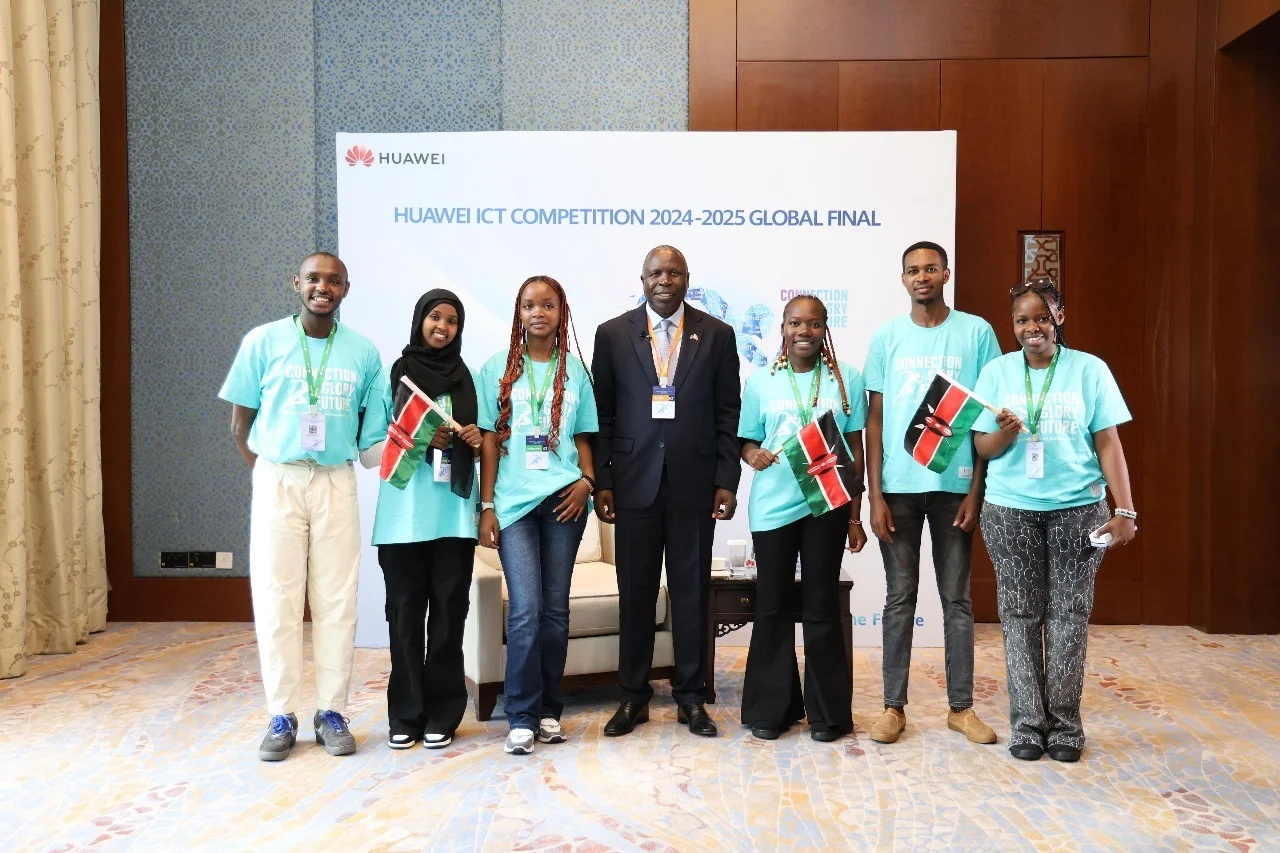
Kenya Huawei winners received national recognition on Tuesday after President William Ruto hosted the students and lecturers at State House in Nairobi.
The Kenyan delegation earned global honors at the 2026 Huawei ICT Competition, one of the world’s largest technology skills contests.
Ruto praised the teams for demonstrating that Kenya has the talent and ambition required to compete in advanced technology fields.
He said the students’ success showed that the country could become a global technology powerhouse by investing in innovation, research and digital skills.
Kenya Huawei Winners Celebrated at State House
Ruto met the students and their lecturers on July 28 following their strong performance at the global finals in Shenzhen, China.
All three Kenyan university teams that qualified for the final stage returned with international awards.
The country’s Cloud Track Team secured the Grand Prize, marking Kenya’s first top award since it began participating in the competition in 2019.
Ruto described the achievement as an important milestone for Kenya’s technology sector and higher education system.
He said countries that develop creators and innovators will be better positioned to lead the global economy.
“The future will not belong merely to those who master today’s technologies,” Ruto said.
“It will belong to those who imagine, invent and build the technologies that the world has not yet conceived, but which will one day redefine economies, transform societies and shape the future of humanity.”
Kenya Wins First Huawei ICT Grand Prize
The Cloud Track Team earned the highest recognition among the Kenyan participants.
Its victory represented the first time Kenya had secured the Grand Prize since joining the Huawei ICT Competition seven years earlier.
The award strengthened Kenya’s growing reputation as a source of skilled technology students capable of competing against leading institutions worldwide.
The President said he was particularly proud that every Kenyan team participating in the finals received global recognition.
The performance highlighted the quality of training offered by Kenyan universities and the potential of students when they receive access to practical technology programs.
Global Competition Attracts 220,000 Participants
The 2026 Huawei ICT Competition attracted more than 220,000 students from over 2,000 learning institutions.
Participants came from more than 100 countries, making the event one of the world’s largest technology training and skills competitions.
Only 177 teams representing 49 countries qualified for the global finals in Shenzhen.
The Kenyan teams therefore faced strong competition from universities and technology institutions across several regions.
Their success placed Kenya among the leading countries represented at the event.
Ruto Links Technology Skills to National Competitiveness
Ruto said the development of skilled technology professionals should be treated as a national economic priority.
He noted that countries are increasingly competing through innovation, scientific research and advanced digital infrastructure.
The President identified artificial intelligence, robotics and quantum computing among the technologies expected to shape future economies.
He also highlighted biotechnology, semiconductor development, autonomous systems, space technology and next-generation communication networks.
According to Ruto, countries that invest in these areas will have a stronger chance of creating jobs, attracting investment and developing globally competitive industries.
“The nations that cultivate innovators rather than mere consumers of technology will be the nations that lead the 21st century,” he said.
Kenya Huawei Winners Highlight Youth Potential
The success of the Kenya Huawei winners comes as the country seeks to expand its digital economy and create more opportunities for young people.
Technology competitions allow students to apply classroom knowledge to real-world challenges.
They also provide exposure to cloud computing, cybersecurity, networking, artificial intelligence and other fast-growing fields.
Such practical experience can help graduates prepare for careers in both local and international technology companies.
The competition also connects students with industry professionals and fellow innovators from different countries.
These networks may support future research, entrepreneurship and technology partnerships.
Universities Play Key Role in Digital Growth
The lecturers honored alongside the students played an important role in preparing the teams for the international competition.
Their involvement demonstrated the value of strong cooperation between universities, technology companies and government institutions.
Universities are expected to produce graduates who can solve practical problems and respond to changes in the global job market.
As industries adopt automation, cloud services and artificial intelligence, educational institutions must continuously update their training programs.
Kenya’s performance at the competition suggests that local universities can develop globally competitive talent when students receive the necessary guidance, equipment and technical exposure.
Huawei Competition Builds Practical ICT Skills
The Huawei ICT Competition is designed to help students improve their technical knowledge and practical abilities.
Participants are tested in several areas of information and communications technology.
The program also encourages teamwork, problem-solving and innovation.
Huawei uses the competition to connect universities with industry training resources and emerging technologies.
For students, participation can provide valuable experience beyond traditional academic examinations.
The global finals allow national teams to test their abilities against some of the strongest technology students in the world.
Technology Talent Could Support Kenya’s Economy
Kenya has positioned the digital economy as an important part of its future development.
The country has built a strong reputation in mobile payments, financial technology and digital entrepreneurship.
However, continued growth will depend on developing more specialists in advanced technical areas.
Artificial intelligence engineers, cybersecurity experts, cloud specialists and semiconductor researchers are expected to become increasingly important.
Training more young people in these fields could help Kenya attract investment and reduce its dependence on imported technology solutions.
It could also support the development of local products designed to solve challenges in agriculture, healthcare, education, transport and public services.
Kenya Huawei Winners Inspire Future Innovators
The State House recognition gave the winning students a national platform and highlighted the importance of celebrating academic and technical excellence.
Their achievement could encourage more young Kenyans to pursue careers in science, engineering and information technology.
It may also inspire universities to expand practical ICT training and participate in more international competitions.
Kenya’s first Grand Prize at the Huawei contest represents more than an individual team victory.
It shows that Kenyan students can compete successfully on the global stage when given the right opportunities.
The challenge now is to turn such achievements into long-term progress through continued investment in education, research and innovation.
The Kenya Huawei winners have demonstrated the country’s potential. Their success offers a clear message that Kenya’s future technology leadership can be built by developing, supporting and trusting its young innovators.