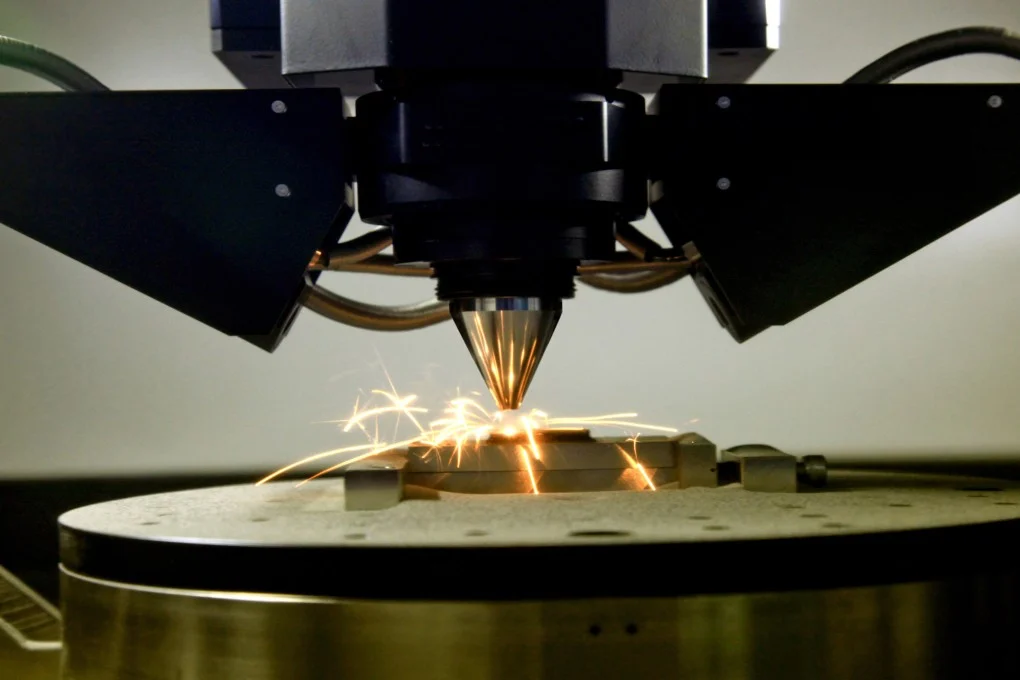
In a groundbreaking achievement, Chinese scientists have developed a new 3D printing technology that can fabricate complex millimeter-scale objects in just 0.6 seconds. This revolutionary speed leap marks a significant advancement in the world of 3D printing, previously hindered by the slow speed-precision trade-off. The development, led by Tsinghua University’s Dai Qionghai and his research team, opens new doors for industries ranging from biomedicine to advanced manufacturing.
Overcoming the Speed-Precision Bottleneck in 3D Printing
Traditional 3D printing methods, particularly those that require high resolution, often take minutes or even hours to create a single object. The challenge has always been balancing speed with precision—slower methods typically ensure accuracy, but this comes at the cost of efficiency. This new technology, however, combines high-speed fabrication with high resolution, achieving 12-micron feature sizes and up to 333 cubic millimeters of printing per second.
The Technology Behind the Breakthrough
The key to this speed revolution lies in the Digital Incoherent Synthesis of Holographic Light Fields (DISH) technology. By manipulating holographic light fields, the researchers can project complex 3D structures quickly and with high precision, eliminating the need for slow, point-by-point scanning. This innovative optical system design allows the Galaxy A07 5G to be printed at a record pace, while also ensuring that each printed object retains intricate details.
Potential Applications and Future Impact
The implications of this technology are vast and transformative. In advanced manufacturing, it could enable the mass production of miniature components, such as photonic chips or smartphone camera modules, which often require sharp angles or curved surfaces. In biomedicine, the ability to print high-resolution tissue models and micro-robots opens new possibilities for research and patient care. This innovation also simplifies the printing process, as it requires only a single optical plane and minimal container movement.
The new millimeter-scale 3D printing technology represents a monumental leap forward in the capabilities of advanced manufacturing and other cutting-edge fields. By overcoming the speed-precision trade-off, this technology sets a new benchmark for 3D printing, enabling faster, more efficient production of complex objects with applications across biomedicine, micro-technologies, and beyond. The future of manufacturing has never been closer to reality.