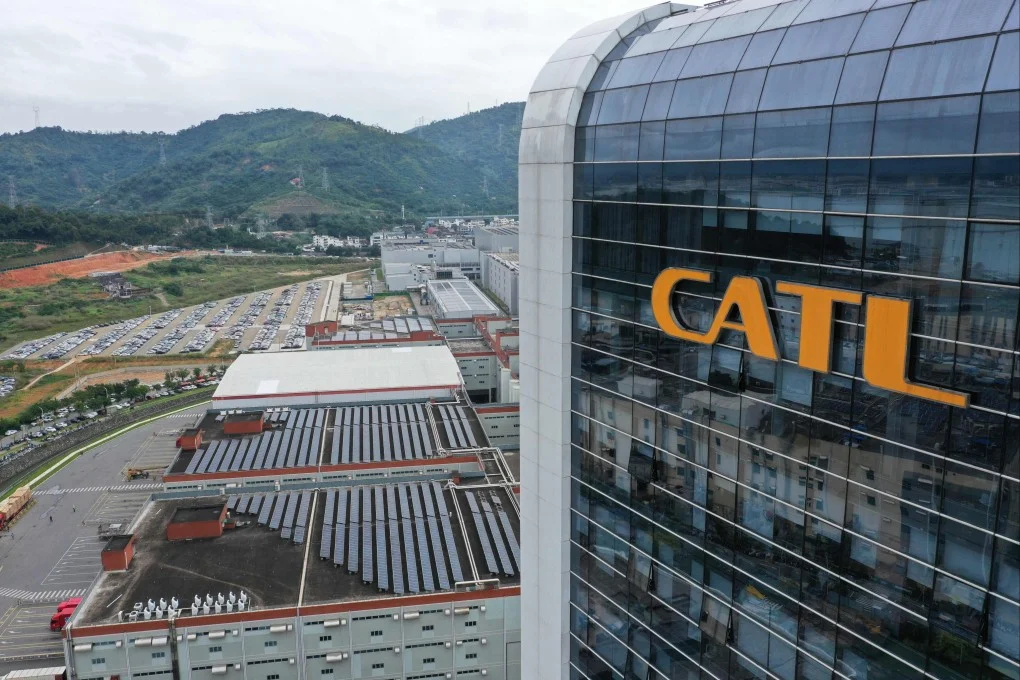
CATL EV battery share climbed to 40.2% globally during the first five months of 2026, strengthening the Chinese manufacturer’s lead in the fast-growing electric vehicle battery industry.
The company also reported a sharp rise in first-half earnings, even as profit margins in its core EV battery systems division narrowed.
CATL recorded net profit of RMB43.284 billion, or about $5.95 billion, for the six months ending in June. That represented an increase of 41.98% from the same period a year earlier.
First-half revenue reached RMB276.9 billion, supported by strong demand for electric vehicle batteries, energy storage products and battery-swapping infrastructure.
However, the results also showed growing pressure on margins as competition intensifies across the global battery market.
CATL EV Battery Share Expands Globally
Figures cited by CATL from South Korea-based research company SNE Research showed that the manufacturer accounted for 40.2% of global EV battery usage between January and May 2026.
Its market share increased by 2.2 percentage points from the same period in 2025.
The latest figures underline CATL’s dominant position in the electric vehicle supply chain. The company manufactures battery cells, modules, packs and enclosures for electric and hybrid vehicles.
It supplies major international automakers, including Volkswagen, Stellantis, BMW, Volvo and Toyota.
CATL remains heavily dependent on its domestic market, with China generating 68.5% of its revenue. However, the company is working to expand internationally as electric vehicle growth in China begins to moderate.
CATL Profit Rises Despite Margin Pressure
CATL’s total gross profit reached RMB66.26 billion during the first half of 2026.
Its overall gross profit margin stood at 23.93%, down from 25.02% a year earlier. In the first half of 2025, the company reported gross profit of RMB44.76 billion.
The decline suggests that CATL is generating more profit in absolute terms while earning slightly less from each unit of revenue.
Price competition among battery manufacturers, falling battery prices and pressure from automakers may be contributing to tighter margins across the industry.
CATL’s large production scale, wide customer base and growing product range have helped it maintain strong earnings despite those pressures.
EV Battery Systems Remain CATL’s Largest Business
CATL’s electric vehicle battery systems division generated RMB192.1 billion in revenue during the first half.
The unit represented 69.38% of the company’s total revenue, making it CATL’s largest business by a wide margin.
Gross profit from EV battery systems reached RMB39.6 billion, while the division’s gross profit margin declined to 20.63%.
That compared with a margin of 22.41% and gross profit of RMB29.49 billion during the first half of 2025.
The results show that CATL’s EV battery business continued to grow, but profitability came under pressure.
Competition is rising as battery makers invest in new factories, improve charging performance and compete for supply agreements with global automakers.
Energy Storage Delivers Stronger Margins
CATL’s energy storage system division accounted for 19.23% of total first-half revenue.
The energy storage business was more profitable than the company’s EV battery systems division, continuing the pattern recorded during the first half of 2025.
CATL supplies battery cells and packs for energy storage projects. It also offers complete systems that can be installed as packaged solutions.
Demand for energy storage is expanding as countries add more solar and wind power to their electricity grids.
Battery systems can store excess renewable power and release it when demand increases or electricity generation falls.
The sector has become an important source of growth for battery manufacturers seeking to reduce their dependence on passenger vehicle sales.
CATL Increases Battery Research Spending
CATL raised its research and development spending by 12.7% during the first half of 2026.
The company spent RMB11.38 billion on research, up from RMB10 billion during the same period in 2025.
The investment reflects the growing competition to develop batteries that charge faster, last longer and operate safely in a wider range of temperatures.
CATL produces lithium iron phosphate batteries, commonly known as LFP batteries. It is also developing several other battery technologies.
Its portfolio includes sodium-ion batteries, high-voltage mid-nickel batteries, high-nickel ternary batteries, condensed batteries and products designed for hybrid vehicles.
The company says these technologies are intended to improve driving range, charging speed, battery life and safety.
CATL has also introduced battery products designed for light commercial vehicles as it targets delivery fleets and other business customers.
China Remains Central to CATL EV Battery Share
China continues to provide the foundation for CATL’s growth.
Data from the China Association of Automobile Manufacturers showed that more than five million new energy vehicles were delivered in the country during the period covered by CATL’s report.
China classifies battery-electric vehicles, plug-in hybrids and some other alternative-powered models as new energy vehicles.
The country remains far ahead of most global markets in electric vehicle production and adoption.
Government policy, extensive charging infrastructure and strong local manufacturing have supported rapid growth.
However, slowing domestic demand could increase the importance of overseas markets for CATL.
Demand for lower-cost Chinese electric vehicles is growing in several regions as governments introduce policies to reduce transport emissions.
International expansion could help CATL maintain growth, although it may also face regulatory barriers, tariffs and pressure from local manufacturers.
CATL Expands Battery-Swapping Network
CATL is also building a large battery-swapping network alongside its battery manufacturing operations.
The company said it had constructed 2,000 Choco-Swap stations for passenger vehicles across China.
Battery swapping allows drivers to replace an empty battery with a charged unit instead of waiting for the vehicle to recharge.
The process can reduce downtime, particularly for taxis, ride-hailing vehicles, delivery fleets and other vehicles that operate for long hours.
CATL launched its swapping initiative with more than 100 partners. It has also worked with several automakers to develop passenger vehicles that are compatible with its stations.
The company has separate battery-swapping partnerships for commercial vehicles in China.
CATL is now upgrading some locations to include ultra-fast charging. The goal is to create a combined network where drivers can either recharge their vehicles or replace their batteries.
European Truck Battery-Swapping Plan Advances
CATL is also taking its battery-swapping strategy outside China.
The company recently announced a joint venture with British energy retailer and clean technology company Octopus Energy.
The partnership plans to develop a battery-swapping network for heavy-duty trucks in Europe.
Electric trucks often require very large batteries and can take longer to recharge than passenger cars. Battery swapping could provide an alternative for fleet operators seeking to keep trucks on the road.
However, building a successful swapping network requires substantial investment, standardized batteries and cooperation among manufacturers.
CATL’s experience in China could help the company test whether the model can work in international freight markets.
CATL EV Battery Share Strengthens Industry Lead
CATL’s first-half results show a company that continues to expand despite increasing pressure on profitability.
Its net profit rose almost 42%, revenue reached RMB276.9 billion and its global EV battery share increased to 40.2%.
At the same time, declining margins in its electric vehicle battery division highlight the growing cost and pricing pressures facing manufacturers.
CATL is responding by increasing research spending, expanding its energy storage business and developing new battery-swapping infrastructure.
Its ability to maintain growth will depend on demand for electric vehicles, international expansion and the commercial success of newer technologies.
For now, the rising CATL EV battery share confirms that the company remains the leading force in the global market, even as competition and margin pressure reshape the industry.