Wearable brain monitoring may soon become more accurate and comfortable after researchers developed a new reusable biogel designed to improve contact between brain-monitoring devices and the scalp. The breakthrough material could help advance electroencephalography systems, virtual reality experiences, prosthetic technology, and future human-computer interfaces.
Scientists at Pennsylvania State University created the thermoreversible semiconducting ionic biogel to solve a long-standing problem in EEG systems. Hair often interferes with electrode contact, while traditional conductive gels dry out over time and reduce signal quality.
How the New Biogel Improves Wearable Brain Monitoring
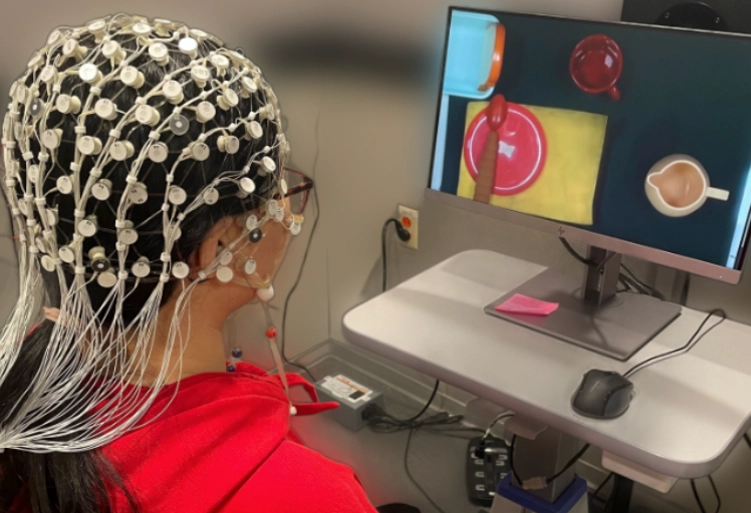
The wearable brain monitoring technology works by using electrodes placed on the scalp to measure electrical activity in the brain. However, obtaining stable readings can be difficult because poor contact between the electrodes and skin weakens the signals.
Researchers designed the new biogel to change form when heated gently. The material temporarily becomes liquid, allowing it to move through hair and reach the scalp more effectively. As it cools, the substance returns to a stable gel while maintaining its conductive properties.
The team said the material remained stable across multiple hair types and maintained performance for several days, outperforming conventional EEG gels that often dry out quickly.
Researchers Explore Neurohaptics Applications
Beyond wearable brain monitoring, the technology could support research into neurohaptics, a growing field focused on how the nervous system experiences both natural and artificial touch sensations.
Scientists believe better understanding touch perception could eventually lead to more immersive virtual reality systems, advanced prosthetic limbs, and improved augmented reality experiences.
Current haptic systems mainly rely on user feedback to determine whether artificial sensations feel realistic. Researchers hope EEG monitoring combined with the new biogel could provide more objective measurements of how the brain responds to touch.
According to the research team, creating artificial touch that feels closer to natural human sensation could transform the future of digital interaction.
What Makes the Biogel Different
The new material combines several components to balance softness, flexibility, and electrical conductivity. The gel includes gelatin, glycerol, ionic liquids, and PEDOT:PSS, a conductive polymer commonly used in bioelectronics.
Researchers discovered that changing the sequence of mixing these ingredients dramatically altered the material’s internal structure and conductivity.
One version produced isolated conductive regions with excellent thermoreversibility, while another created interconnected conductive networks capable of carrying electronic signals more efficiently.
The team said this accidental discovery significantly increased conductivity while preserving the gel’s ability to soften with heat and solidify again during cooling.
Potential Impact on Human-Computer Interfaces
Scientists believe the breakthrough could influence the future of human-computer interaction and physical artificial intelligence systems.
Researchers say most current digital technologies still have limited connection with natural human touch. By understanding how individuals perceive touch sensations, developers may eventually create personalized artificial touch systems for robotics, prosthetics, and immersive digital environments.
The study’s authors also described the technology as a broader material platform rather than a single-use invention, suggesting the approach could potentially apply to other advanced material systems in the future.
Why This Matters
The development highlights growing efforts to improve wearable brain monitoring systems and strengthen the connection between humans and digital technologies.
As interest in brain-computer interfaces, augmented reality, and AI-powered devices continues rising, researchers are searching for more reliable and comfortable ways to capture neural activity over long periods.
What Happens Next
Scientists are expected to continue testing the biogel in wearable systems and neurohaptics applications. Future research could focus on improving long-term durability, scaling production, and integrating the technology into commercial medical and consumer devices.