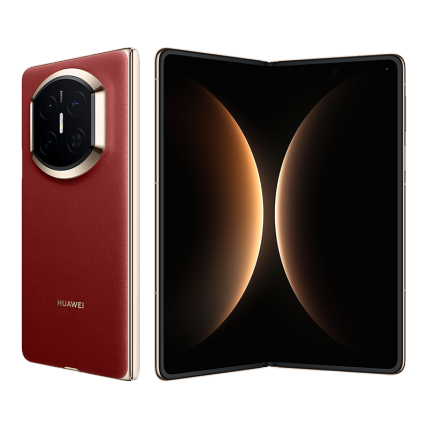
The Huawei Mate X7 enters the foldable market with a premium design, ultra-thin profile, and a camera system that stands out in a crowded flagship segment. On paper, the Huawei Mate X7 looks like a serious rival to devices such as the Samsung Galaxy Z Fold7 and Honor Magic V5, especially for buyers who care about photography.
However, the Huawei Mate X7 also comes with major compromises that are hard to ignore at this price. While its cameras, battery life, and build quality impress, the lack of 5G, limited Google support, and weaker chipset make it a harder sell against competing foldables in 2026.
Huawei Mate X7 design feels premium but comes with extra weight
The Huawei Mate X7 makes a strong first impression thanks to its slim build and polished finish. When unfolded, it measures just 4.5 mm thick, while folded it comes in at 9.5 mm. That gives it a sleek profile that feels close to a conventional flagship phone despite its foldable design.
Build quality is one of the Huawei Mate X7’s strongest points. The phone feels premium in hand and carries IP59 certification for water resistance. Huawei has also upgraded the device with a USB 3.1 port, which allows faster data transfers and wired display output with optional desktop mode support.
Still, the device is not perfect. At 236 grams, the Huawei Mate X7 is noticeably heavier than some of its main foldable rivals. The crease is also still visible and tactile, which makes it feel less advanced than some newer crease-minimizing competitors.
Huawei Mate X7 cameras are the highlight
The biggest strength of the Huawei Mate X7 is clearly its camera system. For a very thin foldable phone, Huawei has delivered a strong photography package that competes well within the segment.
The main camera uses a 50 MP sensor with a variable aperture ranging from f/1.49 to f/4.0. Image quality is strong, with very good sharpness and dynamic range. Photos look detailed and balanced, which makes the phone especially appealing for users who want a foldable without sacrificing camera quality.
Huawei also adds a 40 MP ultra-wide camera and a 50 MP periscope telephoto lens with 3.5x zoom. That telephoto camera is a major advantage for the Huawei Mate X7 and helps it stand out from many rivals. In fact, the overall setup may be one of the best camera packages currently available on a foldable phone.
Low-light performance is solid, though not class-leading. Given the sensor technology, some users may expect a little more brightness at night. Even so, the cameras remain one of the strongest reasons to consider this device.
Huawei Mate X7 display delivers solid quality
The Huawei Mate X7 comes with an 8-inch OLED main display that supports a 120 Hz refresh rate and a resolution of 2416 x 2210 pixels. The panel looks sharp and smooth, making it well suited for media, reading, and multitasking.
Brightness on the main display is good, reaching about 1,500 nits in HDR and APL testing. That is enough for comfortable indoor use and decent outdoor visibility, though some competitors, especially Samsung’s foldables, are brighter.
Color accuracy is another strong point. The display performs well in calibration tests and delivers accurate colors for day-to-day viewing. Response times are also very fast, which benefits gaming and smooth scrolling.
The outer 6.49-inch display is even brighter than the main screen. It also supports 120 Hz and offers very strong peak brightness, making it easier to use outdoors. For many users, the cover display may end up being one of the most practical parts of the Huawei Mate X7 experience.
Huawei Mate X7 performance falls behind rivals
This is where the Huawei Mate X7 starts to lose momentum. The phone is powered by the HiSilicon Kirin 9030 Pro, but benchmark results show that it trails behind other flagship foldables powered by Qualcomm chips.
In daily use, the Huawei Mate X7 performs well enough for regular tasks. Apps open smoothly, navigation feels responsive, and general use is satisfactory. However, once you compare it to Snapdragon-powered rivals, the gap becomes obvious.
CPU and GPU results place the phone closer to upper mid-range territory than true flagship level. Gaming performance is decent in some titles, but more demanding workloads reveal its limits. Thermal throttling is also noticeable in stress tests, with performance dropping significantly under sustained load.
For a foldable priced above €2,000, that is a major weakness. Buyers spending this much usually expect top-tier performance, and the Huawei Mate X7 simply does not deliver that consistently.
Huawei Mate X7 battery life is good
Battery life is one area where the Mate X7 holds up well. It packs a 5,600 mAh battery, which is a solid size for a foldable phone, and the results are respectable.
In Wi-Fi web browsing tests, the phone lasted around 17 hours. That is a strong result and should easily cover a full day of use for most people. Charging is also competitive, with support for 66 W wired charging and 50 W wireless charging.
A full charge takes around 45 minutes, which is quick enough for a premium device. While some rivals still last longer, the Mate X7 battery performance is good overall and adds to its appeal.
Huawei Mate X7 still lacks Google and 5G
The biggest limitations of the Mate X7 are not just about raw performance. Software and connectivity remain major drawbacks.
The phone ships with EMUI 15 based on open-source Android 12, but it does not include Google services or the Google Play Store. Users can rely on workarounds such as the Aurora Store, but this is still not the same as native Google support.
That issue alone will be a deal-breaker for many buyers outside China. In addition, the Mate X7 still does not support 5G. For a premium foldable in 2026, that feels like a serious omission.
Wi-Fi 7 is supported, but the phone does not use the 6 GHz band. As a result, wireless performance is not as advanced as some competing devices. These limitations make the Mate X7 feel less future-ready than other premium foldables.
Is the Huawei Mate X7 worth buying?
The Mate X7 is a stylish and capable foldable with a lot going for it. Its cameras are excellent for this category, the design feels premium, the displays are strong, and battery life is reliable.
At the same time, the Huawei Mate X7 is held back by a weak chipset, missing 5G support, and the lack of native Google services. Those are not small issues. At its asking price, buyers have every right to expect fewer compromises.
For users who prioritize photography and want a premium foldable with a slim body, the Mate X7 has clear strengths. However, for buyers who want the most complete foldable experience, several rivals still offer better overall value in 2026.